


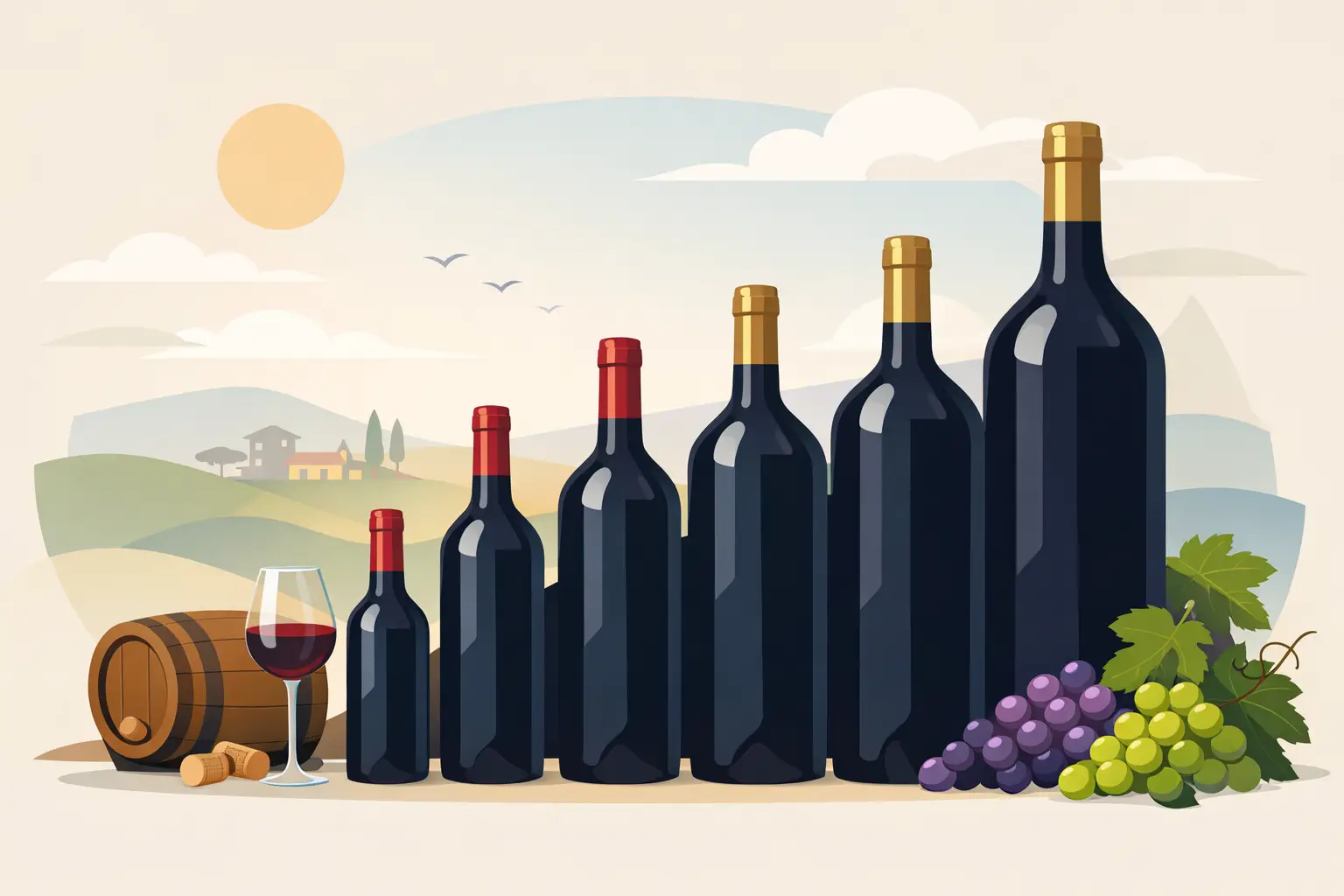
A bottle’s volume changes more than the amount poured. Wine bottle sizes affect how a Champagne develops on lees, how confidently a mature Bordeaux can be shared, how much refrigerator space a dinner party requires, and even whether a special bottle feels appropriately generous for the occasion. A 750ml bottle remains the reference point, but choosing beyond it can make a thoughtful difference to drinking, gifting, and collecting.
The standard wine bottle size: 750ml
A standard bottle holds 750ml, or just over 25 fluid ounces. That equates to five 5-ounce restaurant-style servings, though a more generous home pour may mean four glasses. It is the most practical format for a weeknight dinner, a gift for one or two people, or a tasting where several wines will be opened.
There is also a cellar reason for its dominance. Nearly every producer, from a precise Chablis domaine to a great Pauillac château, releases its principal bottling in 750ml. It is the easiest format to compare across vintages, find in a broad range of price tiers, and store in conventional wine racks.
For most buyers, the standard bottle is still the best starting point. Yet it is not always the best format for the wine itself. Fine wine matures differently according to the ratio of wine to oxygen trapped beneath the cork, and larger bottles typically evolve more slowly and gracefully.
Wine bottle sizes at a glance
Wine bottle names can be charming, but volumes are more useful. Naming conventions also vary between still wine regions and Champagne, so check the stated capacity rather than relying on the name alone.
Small formats: quarter bottles and halves
A quarter bottle, often called a split or piccolo, holds 187.5ml. It is roughly one generous glass and is common for sparkling wine, single-serve occasions, airline service, and hotel minibars. For a celebration where each guest receives an individual bottle of Champagne, it is an appealing format, though it offers less value per milliliter than a standard bottle.
A half bottle holds 375ml, equal to two to three glasses. Half bottles are especially useful for solo drinking, couples who want a proper wine with dinner without opening a full bottle, or a small dessert-wine pour. Sauternes, Tokaji, vintage Port, and late-harvest wines are frequently sold in halves because their richness means a little goes a long way.
For collectors, half bottles deserve a note of caution. They generally mature faster than standard bottles because there is more oxygen exposure relative to the volume of wine. That can be useful when you want to enjoy a classified Bordeaux sooner, but it makes them less suitable for extended cellaring.
The magnum: 1.5 liters
A magnum holds 1.5 liters, the equivalent of two standard bottles or about 10 glasses. It is arguably the most compelling large format: festive enough for a dinner table, manageable to chill and pour, and genuinely beneficial for aging.
Because a magnum contains twice the wine but only one closure, the wine usually develops more slowly than it does in 750ml. The result can be especially striking in age-worthy wines with structure and freshness – Bordeaux, Barolo, Brunello di Montalcino, Northern Rhône Syrah, top Burgundy, and prestige Champagne all have a strong case for being bought in magnum.
A magnum also makes a sophisticated host gift. It says the bottle is intended to be opened and enjoyed in company, rather than placed on a shelf and forgotten. For six to eight guests over a long dinner, it is a sensible quantity; for a larger group, it works best alongside additional bottles rather than as the only wine on the table.
Large formats: 3 liters and above
From 3 liters upward, wine becomes both a serving format and an event. A 3-liter bottle contains four standard bottles, while a 6-liter holds eight. These are memorable centerpieces for milestone birthdays, corporate dinners, weddings, holiday lunches, and celebratory restaurant gatherings.
The most commonly encountered large formats include:
- 3 liters: Double Magnum in Bordeaux; Jeroboam in Champagne
- 4.5 liters: Jeroboam in Bordeaux; Rehoboam in Champagne
- 6 liters: Imperial in Bordeaux; Methuselah in Champagne
- 9 liters: Salmanazar
- 12 liters: Balthazar
- 15 liters: Nebuchadnezzar
At these sizes, the name is secondary to the logistics. A 6-liter Imperial weighs substantially more than six ordinary bottles once glass is included, needs a stable serving surface, and may require two people to pour comfortably. It also needs advance planning for storage, transport, chilling, and a suitably large corkscrew.
Why larger bottles can age more beautifully
The appeal of a large format is not merely theatrical. Wine changes through very gradual oxygen exchange around the closure. In a magnum or Imperial, the amount of wine is greater while the closure remains broadly similar in size, reducing oxygen exposure per milliliter. This slower evolution can preserve fruit, freshness, and tannin structure for longer.
That does not mean every wine should be purchased in large format. A vibrant, early-drinking Sauvignon Blanc or uncomplicated red designed for immediate pleasure may offer little additional reward in magnum. With wines selected for complexity over decades, however, the difference can be meaningful. A mature magnum of Saint-Émilion or vintage Champagne often shows remarkable energy, with a refined aromatic profile and a breathtakingly long finish.
Provenance remains paramount. A large bottle from a great producer is not automatically superior if it has been poorly stored, has an uncertain history, or was released in limited quantities without reliable handling. For collectible formats, buy from a specialist merchant that can speak clearly about source, condition, and storage.
Choosing the right bottle size for your occasion
Start with guest count, but do not stop there. For a seated dinner, estimate two glasses per person if wine is one part of the meal, and closer to three if the wine is central to the evening. One standard bottle is sufficient for two people who are each enjoying a few glasses. A magnum comfortably serves six for an aperitif or four to six through a meal, depending on pours.
Champagne follows a slightly different rhythm. A standard bottle gives six modest flutes, but a reception can move quickly. A magnum is ideal for a small celebratory group because it provides 12 flutes and keeps the ritual of opening a special bottle intact. For a wine dinner, however, several 750ml bottles can be preferable: they allow guests to compare vintages, producers, or styles.
Gifting depends on the recipient. A half bottle of mature Sauternes can be a gracious, focused gift for a dessert-wine enthusiast. A standard bottle of a critically acclaimed vintage is versatile and easy to enjoy. A magnum carries more ceremony, particularly for a housewarming, milestone, or festive family meal. The best choice is not necessarily the biggest bottle, but the one that suits the recipient’s cellar and drinking habits.
Storage, chilling, and serving considerations
Before purchasing a large format, measure your storage space. Many standard racks do not accommodate magnums, and bottles of 3 liters or more may need to be stored on their side in a dedicated section of a wine fridge or cellar. Keep them cool, dark, and free from vibration, just as you would a standard bottle.
Allow more time to chill large bottles. A magnum of Champagne may need several hours in a refrigerator or roughly 30 minutes in an ice-and-water bath. Larger formats require more patience and more ice. Do not rely on a freezer for last-minute chilling: uneven cooling and forgotten bottles are an expensive combination.
When serving mature large-format red wine, stand the bottle upright well in advance so sediment can settle. Decanting depends on the wine’s age and condition, not simply its size. A young, dense Barolo may welcome air; a fragile older Burgundy may be better poured gently and enjoyed without a long decant.
At Crystal Wines, bottle format is worth treating as part of the selection, alongside producer, appellation, vintage, and critic perspective. A well-chosen size turns a fine bottle into the right bottle for the moment – whether that is a quiet dinner for two, a cellar purchase intended for decades, or a table full of people ready to raise a glass.


