


A great bottle should not meet its end at the hands of a blunt screw, a crumbling cork, or an opener that feels more theatrical than dependable. The best wine openers do more than remove a closure: they protect the wine, preserve the mood at the table, and give older bottles the care they deserve.
For most drinkers, one excellent waiter’s corkscrew will cover the majority of bottles. But collectors opening mature Bordeaux, hosts pouring Champagne for a full table, and anyone who regularly encounters fragile natural cork will benefit from choosing the tool for the occasion rather than relying on a single gadget.
The best wine openers are chosen by bottle, not novelty
A wine opener is only as good as its match with the cork and the setting. Young wines with firm corks reward speed and simplicity. A decades-old bottle with a softened cork calls for patience and a gentler extraction method. Meanwhile, screw caps ask for no opener at all, although a clean, controlled twist still matters when serving guests.
The most useful collection is not necessarily the largest. It is a small set of well-made tools: a reliable waiter’s corkscrew for daily use, a two-prong opener for delicate corks, and, for serious cellars, a specialist opener that combines both approaches. Add a foil cutter only if you prefer it, since the small knife on a quality corkscrew is usually more precise.
1. The double-hinged waiter’s corkscrew
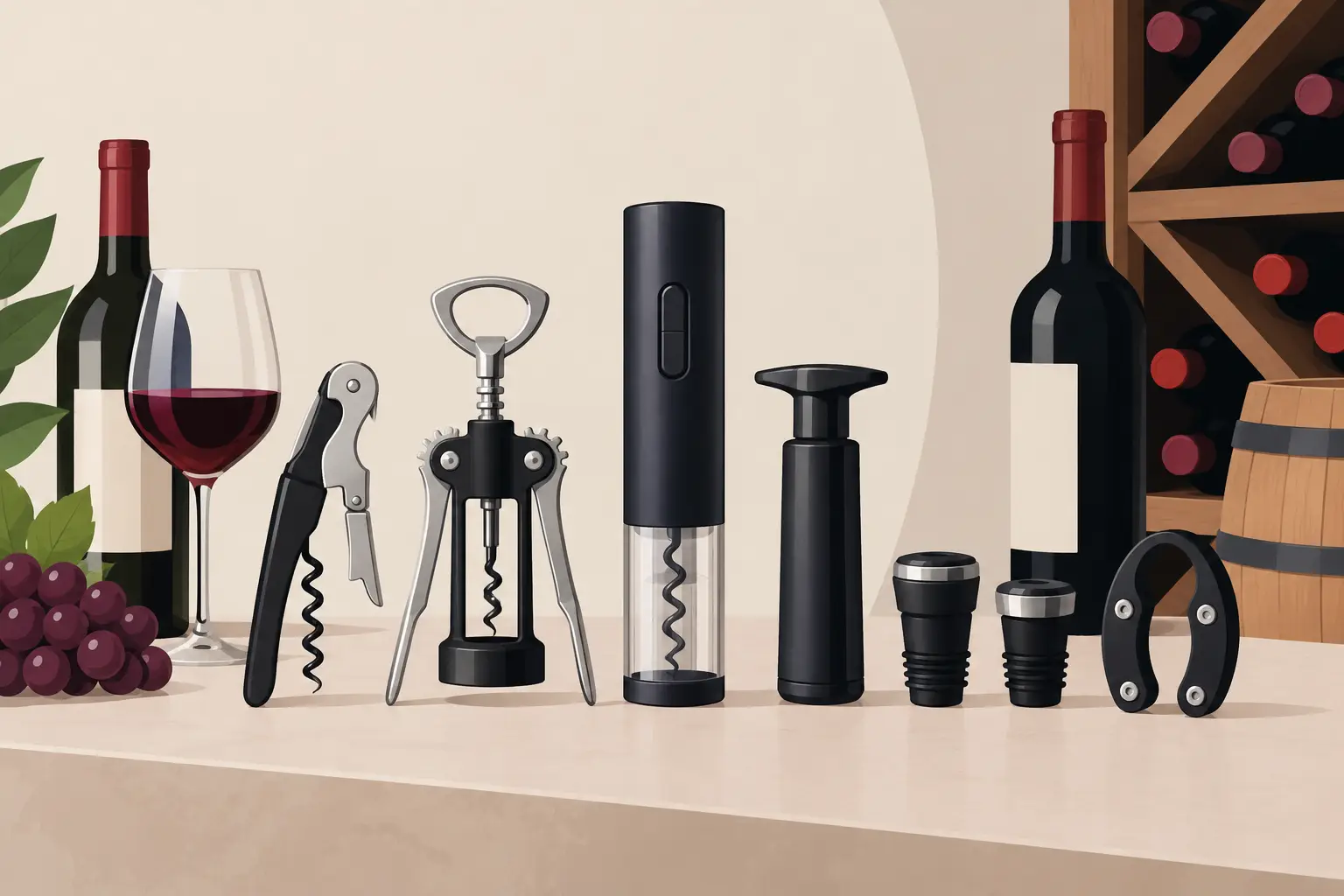
This is the essential wine tool, and for good reason. A double-hinged waiter’s corkscrew offers leverage in two stages, making extraction smooth without excessive pulling. Its compact form belongs in a kitchen drawer, picnic basket, or host’s apron, and a well-shaped serrated blade makes short work of foil.
Look for a sharp, narrow worm with at least five turns. The worm should enter cleanly without chewing up the cork, while the hinged boot should sit securely on the bottle lip. Avoid very cheap models with a thick painted spiral or loose hinge. They can split a cork, slip during extraction, and turn a simple opening into an avoidable mess.
For young reds, whites, rosés, and most standard 750ml bottles, this is the opener to reach for first. It is also the best choice for anyone learning proper opening technique, because it gives direct feedback on the cork’s condition.
2. The winged corkscrew
The winged corkscrew remains familiar, approachable, and easy to use. Turn the center handle, the arms rise, then press both wings down to pull the cork. For casual entertaining, it can feel intuitive, especially for guests who are less comfortable with a waiter’s corkscrew.
Its limitation is control. A winged model can place uneven pressure on a long or fragile cork, and the mechanism is often too bulky for bottles with pronounced lips or unusual shapes. It is best reserved for young, sound corks rather than prized older vintages.
Choose one with a sturdy metal frame and a smoothly turning worm, not a lightweight version that flexes under pressure. It is a perfectly reasonable household tool, but it is not the most versatile option for a wine-focused home.
3. The vertical lever opener
A vertical lever opener is designed for effortless opening at speed. The bottle sits in a cradle, the lever lowers to drive in the worm, then lifts to extract the cork. Many models remove a cork in seconds and include a spare worm, making them useful for large dinners or frequent entertaining.
This style suits hosts who want a polished service ritual without the technique required by a waiter’s corkscrew. It can be particularly convenient when several bottles need opening before guests arrive. The trade-off is size: lever openers occupy more counter and storage space, and lower-quality mechanisms may grip the cork too aggressively.
For sound, modern corks, a well-engineered lever opener is a pleasure. It is less compelling for old bottles, where seeing and feeling every stage of extraction is part of avoiding damage.
4. The electric wine opener
Electric openers have a clear role: accessibility. For someone with reduced hand strength, arthritis, or limited dexterity, an electric model can make wine service much more comfortable. Place it over the bottle, press the button, and the cork is lifted with minimal effort.
The convenience is real, but so are the compromises. Battery-powered models require charging or replacement batteries, may struggle with very long corks, and provide little tactile information if a cork is dry or breaking apart. They are best used for recently bottled wines with dependable closures.
An electric opener can be an excellent gift when ease of use is the priority. For a collector’s cellar, it should be a supplementary tool rather than the only one on hand.
Best wine openers for older vintages
Mature bottles deserve a different approach. Corks become more fragile with age, particularly when storage has been inconsistent or the wine has spent decades in bottle. A conventional worm can tear through the center, leaving the lower portion lodged in the neck. That does not mean the wine is lost, but it does mean more careful service and often decanting through a fine filter.
5. The Ah-So two-prong opener
The Ah-So, sometimes called a butler’s friend, uses two slim metal prongs that slide between cork and glass. Once seated, the opener is twisted and gently pulled upward, removing the cork from the sides rather than piercing its center.
It is particularly valuable for older bottles with a damp, brittle, or visibly compromised cork. It is also useful when a cork has begun to break after an attempted extraction with a standard corkscrew. The technique requires a light hand: ease the longer prong down first, work the shorter prong alongside it, then twist gradually. Forcing either prong can push the cork into the bottle.
An Ah-So is not just for collectors. It is an inexpensive safeguard for anyone who buys mature Rioja, vintage Port, aged Barolo, or cellar releases with a few years behind them.
6. The Durand-style old-vintage opener
For bottles of real age and value, a Durand-style opener is widely regarded as the most secure solution. It combines a traditional worm with two Ah-So prongs. The worm stabilizes the cork through its center while the prongs support the weakened outer edge, so the entire cork can be lifted as one piece.
This is a specialist instrument, and its price reflects that. It is not necessary for Tuesday-night wine. But for mature Bordeaux, older Burgundy, or bottles saved for an anniversary dinner, it can be the difference between an elegant opening and a rescue operation.
Use it slowly. Cut the capsule below the lip, wipe the exposed neck, insert the worm only far enough to avoid piercing the cork’s base, then guide in the prongs. A gentle twist-and-lift motion is safer than a straight pull. Once removed, inspect the cork and wipe the bottle lip before pouring.
7. The sparkling wine opener is your hand
Champagne and other sparkling wines do not need a corkscrew, yet they deserve one of the most disciplined opening techniques in wine service. Remove the foil, keep a thumb on the cork while loosening the wire cage, then hold the cork firmly and turn the bottle, not the cork. The goal is a restrained sigh, not a dramatic pop.
A dedicated Champagne stopper is worth keeping after opening, especially when the bottle will be revisited the next day. It should clamp securely around the neck rather than merely press into it. Even then, freshness is finite, so enjoy the remaining wine promptly.
What separates a good opener from a frustrating one
Build quality matters more than decorative finishes. A good worm is made from durable metal, sharply pointed, and narrow enough to enter the cork without causing it to crumble. A good hinge or lever feels firm rather than loose. On a waiter’s corkscrew, the bottle-resting boot should be broad enough to stay stable and shaped to fit under the lip.
Consider the bottles you actually open. If your table sees mostly young, everyday wines, invest in a comfortable double-hinged corkscrew and practice with it. If you keep fine wines for milestones, add an Ah-So before the first older cork challenges you. If mature bottles are central to your cellar, a Durand-style tool is a sensible form of insurance.
It is also wise to keep a few supporting items nearby: a clean service cloth, a small flashlight for examining sediment, and a fine strainer for the rare cork that fails despite every precaution. These are not signs of pessimism. They are the quiet preparations that allow a memorable bottle to remain the center of attention.
For a thoughtful wine gift, pairing a polished waiter’s corkscrew with a well-chosen bottle is hard to improve upon. For a cellar built around provenance, vintage character, and patient aging, choose the opener with the same care you give the wine. The first pour will feel all the more rewarding when the cork comes away cleanly.


