


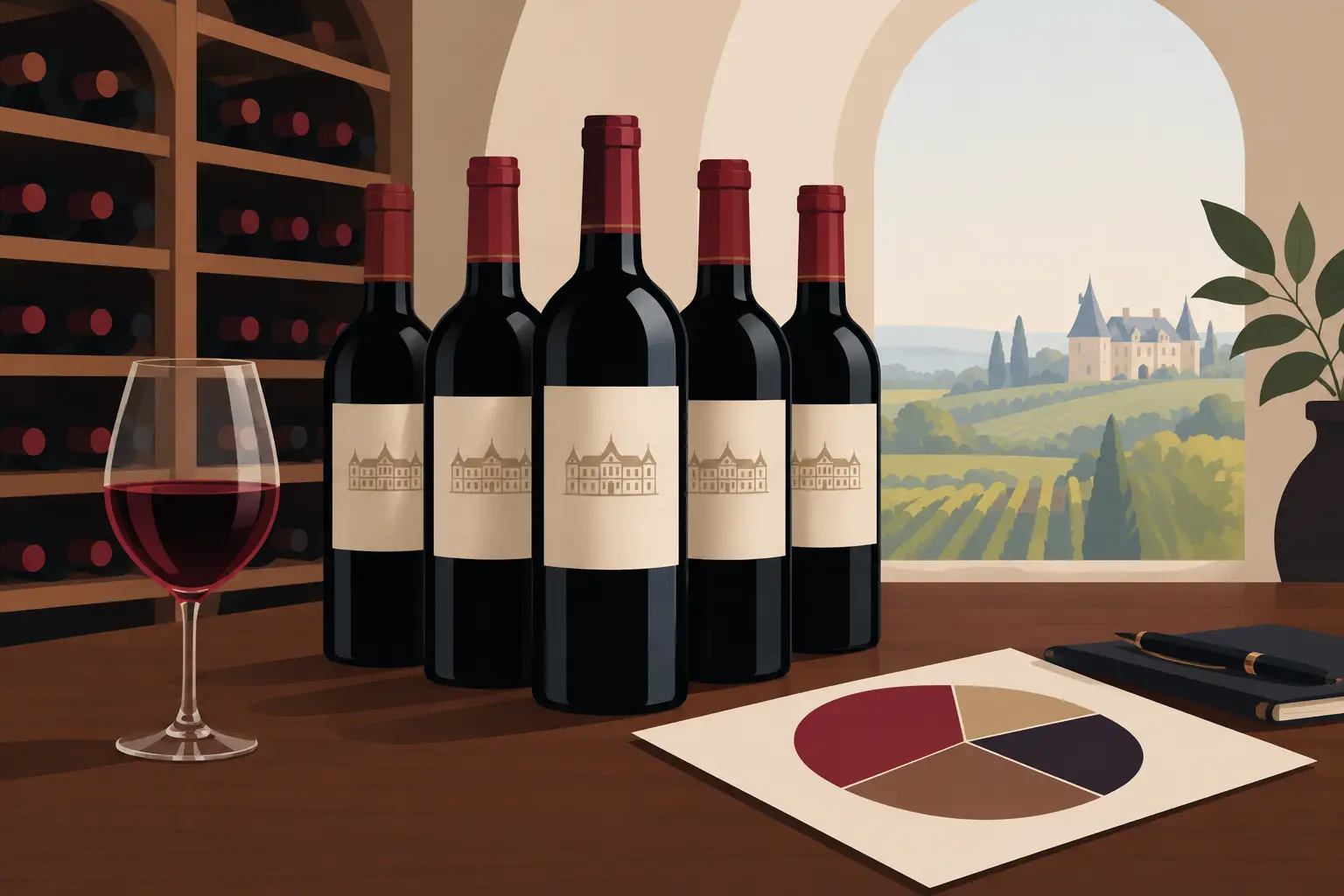
A thoughtful Bordeaux portfolio allocation is not a race to own the most famous labels. It is a way to make sure the bottle opened for a Saturday roast, the case laid down for a milestone birthday, and the magnum brought to a dinner party each have a distinct and satisfying role. Bordeaux remains one of the few regions with the depth, track record, and stylistic range to support that kind of cellar.
For collectors, the appeal is clear: celebrated châteaux, clearly defined appellations, a long record of critical assessment, and wines that can evolve beautifully over decades. Yet the best allocation is personal. A collector who opens bottles regularly needs a different mix from one building a long-term cellar, while a host who favors ribeye and lamb should buy differently from a drinker drawn to the fragrance and freshness of Cabernet Franc.
Start With the Purpose of Your Bordeaux Cellar
Before choosing estates, decide how your wines will be used over the next five to 15 years. Bordeaux is often purchased with patience in mind, but a cellar built entirely around young first growths can become magnificent and impractical at the same time. It is far more rewarding to include bottles that are ready, bottles approaching their prime, and wines that will reward a longer wait.
A useful starting point is to reserve roughly half of a Bordeaux budget for wines intended for enjoyment within one to seven years. These can include mature vintages from reputable estates, supple right-bank wines, and well-made Crus Bourgeois or satellite appellations. The remaining portion can be divided between benchmark long-term bottles and carefully selected estates with rising reputations.
This is not a fixed formula. If you drink Bordeaux only on major occasions, a greater share can sit in the long-term category. If you entertain frequently, the near-term portion deserves more attention. The key is avoiding a cellar where every bottle asks for another decade of restraint.
Build the Core With Benchmark Appellations
The Médoc provides the classical backbone of a Bordeaux collection. Pauillac is prized for its cassis, cedar, graphite, and powerful structure, particularly from estates such as Château Lafite Rothschild, Château Latour, Château Mouton Rothschild, Château Lynch-Bages, and Château Pichon Baron. These are reference points for Cabernet Sauvignon-based claret, often at their most compelling after significant bottle age.
Saint-Julien offers a different kind of assurance: refinement, balance, and an elegant tannin profile that makes the wines wonderfully adaptable at the table. Châteaux Léoville Las Cases, Ducru-Beaucaillou, and Léoville Barton are natural choices for collectors who value both longevity and poise.
Margaux brings a more sensual register, with violet perfume, silky texture, and a graceful line that can be breathtakingly complex with age. Château Margaux, Palmer, Rauzan-Ségla, and Brane-Cantenac illustrate the appellation’s range across prestige and relative value. Graves and Pessac-Léognan add another vital dimension, often marked by tobacco leaf, warm earth, and smoky nuance. Haut-Brion and La Mission Haut-Brion sit at the summit, while Haut-Bailly and Domaine de Chevalier merit serious attention.
A left-bank core does not require every famous name. It is often wiser to buy more deeply from a few estates whose style you know and enjoy than to collect single bottles of every headline château.
Balance Cabernet Structure With Right-Bank Texture
Saint-Émilion and Pomerol bring Merlot and Cabernet Franc to the center of the picture. Their wines can be plush, savory, floral, and deeply layered, with earlier approachability in many vintages than their Cabernet-driven counterparts across the Gironde.
For blue-chip cellaring, Château Cheval Blanc, Ausone, Figeac, Angélus, Pétrus, and Vieux Château Certan represent extraordinary benchmarks. There is also considerable pleasure in estates that deliver personality without requiring trophy-wine pricing. Canon, Bélair-Monange, Larcis Ducasse, La Conseillante, and Clinet can offer sensational perfume, finely worked tannins, and the kind of detail that makes a bottle memorable at the table.
A balanced Bordeaux portfolio allocation often gives meaningful space to the right bank. It keeps the cellar from becoming stylistically uniform and provides more options when a dinner calls for velvet texture rather than firm Cabernet architecture.
Let Vintage Guide the Buying Decision
Estate matters, but vintage shapes how an estate will drink. Warm, generous years can offer immediate charm, rich fruit, and supple tannins. Cooler or more structured years may show greater reserve in youth, then gain nuance and harmony with time. Neither profile is automatically superior.
Highly regarded vintages such as 2000, 2005, 2009, 2010, 2015, 2016, 2018, 2019, and 2020 deserve attention, but their personalities differ. The 2009s are often expansive and seductive, while 2010 generally has more drive and classical structure. The 2016s combine freshness with depth and are widely admired for balance. The 2019s can be expressive and refined, whereas 2020 often delivers concentration and energy.
Less celebrated vintages should not be dismissed. At the right estate, years such as 2014 and 2017 can offer excellent value, particularly for buyers who appreciate a more traditional, less opulent Bordeaux profile. Mature bottles from modest vintages can also be ideal for immediate drinking, provided storage history is impeccable.
Critic scores are valuable signals, especially when comparing estates across a broad offer, but they should be read alongside vintage style, drinking window, and your own preference. A 96-point wine you will not open is less useful than a 93-point bottle perfectly suited to your table.
Use Formats and Case Sizes Intelligently
Standard bottles make up the working heart of most cellars. They are easy to open, easy to share, and allow you to follow a wine’s evolution over time. Buying six or 12 bottles of a favorite château gives you the freedom to open one young, revisit it at intervals, and still keep bottles for maturity.
Magnums deserve a considered place in any serious collection. Their slower evolution can preserve freshness, and they bring real occasion to a dinner for six to eight guests. For festive gatherings, a magnum of mature Saint-Julien or Saint-Émilion offers both theater and generous pours. Larger formats are thrilling but should be purchased only when you have the storage and social occasions to justify them.
Original wooden cases can matter to collectors who prioritize provenance, presentation, and future resale flexibility. However, a pristine case should never override the more basic questions: Do you love the estate? Is the vintage compelling? Can you store it properly? Fine wine is first meant to be enjoyed.
Keep Room for Discovery and Value
The most satisfying Bordeaux cellars include discoveries beyond the classified-growth hierarchy. Look to strong estates in Haut-Médoc, Moulis, Listrac, Fronsac, Lalande-de-Pomerol, and the wider Saint-Émilion area. These wines can deliver the region’s signature character at a price that encourages regular opening.
This is also where professional guidance earns its place. A merchant with a serious Bordeaux selection can help distinguish a merely fashionable release from an estate with genuine upward momentum, dependable winemaking, and a style that suits your palate. At Crystal Wines, that conversation can extend from critic-backed collector bottles to practical selections for a home dinner or thoughtful gift.
Store With the Same Care You Buy
Bordeaux rewards disciplined storage. Keep bottles in a dark, vibration-free environment at a stable temperature, ideally around 55°F, with sufficient humidity to protect natural corks. In a warm climate, professional temperature-controlled storage is not a luxury for serious purchases. It is part of protecting the wine’s provenance and future pleasure.
Record what you own, including vintage, format, purchase date, source, and intended drinking window. A simple cellar inventory prevents accidental duplication and reveals gaps in your allocation. You may find that you have plenty of monumental wines for 2035 but nothing graceful to pour next month.
The finest Bordeaux portfolio is not the one that impresses most on paper. It is the one that gives you the right bottle when friends arrive, when a great meal is on the table, or when time has done its quiet work in the cellar. Buy with a plan, leave room for surprise, and open the wines while their stories are still yours to share.


