


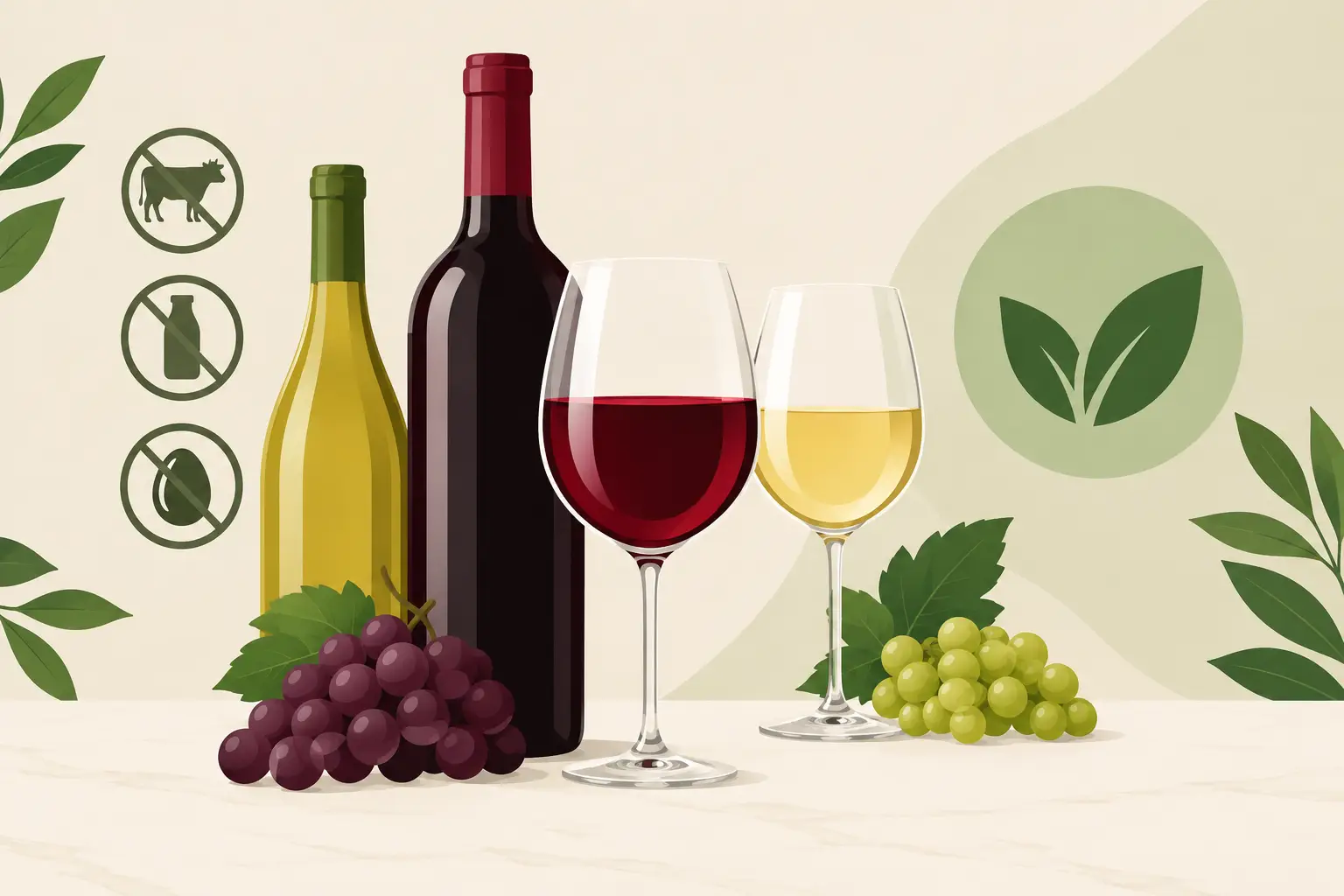
A bottle can contain nothing more recognizable than grapes, yeast, and sulfur dioxide, yet still leave a vegan drinker with a reasonable question at the dinner table: what makes wine vegan? The answer is usually not about the vineyard or fermentation. It comes down to the quiet decisions made in the cellar, particularly whether a winemaker uses animal-derived agents to clarify and soften a finished wine.
For hosts choosing a bottle for a plant-based menu, or collectors assessing a producer’s practices before opening a prized vintage, the distinction is worth understanding. Vegan wine can be every bit as layered, age-worthy, and evocative of place as any other bottle. It simply avoids animal-derived inputs during winemaking.
What Makes Wine Vegan in the Cellar?
Wine begins as a naturally vegan product. Grapes are harvested, crushed or pressed, and fermented by yeast into alcohol. During and after fermentation, however, young wine can hold suspended particles: spent yeast cells, proteins, tannins, color compounds, and tiny fragments of grape solids. These are not necessarily faults. In fact, some winemakers deliberately keep them in the wine for texture and complexity.
Others choose to fine the wine. Fining is a clarification and stabilization process in which a substance is added to bind with certain particles, making them easier to remove by racking or filtration. It can make a wine brighter in appearance, more polished in texture, and less prone to developing sediment or haze in bottle.
A wine is considered vegan when its production does not use animal-derived fining agents or other animal-based processing aids. The final liquid may contain no measurable trace of these agents after filtration, but many vegan consumers avoid wines made with them at any stage. That is why the method matters, not only what remains in the glass.
The traditional agents that may make a wine non-vegan
Several classic fining materials are animal-derived. Egg whites, also called albumin, have long been used to refine firm, tannic red wines, particularly in traditional cellars. The technique can gently soften a young Cabernet Sauvignon, Bordeaux blend, or Barolo while preserving its structure.
Casein, a protein derived from milk, may be used to reduce bitterness or oxidation-related color in white wines. Gelatin, made from animal collagen, can remove astringency and clarify both red and white wines. Isinglass, derived from fish bladder, is another historic clarifier, especially associated with delicate white wines and some sparkling wine production.
None of these practices automatically signals inferior winemaking. They are established cellar tools, often selected with care by producers pursuing balance and finesse. But their use means the wine would not meet a strict vegan standard.
Vegan Alternatives to Traditional Fining
Today, winemakers have numerous vegan-friendly options. Bentonite, a naturally occurring clay, is widely used to stabilize white wines by removing proteins that could otherwise create haze. Activated charcoal, silica-based products, and PVPP, a synthetic polymer used to manage certain phenolic compounds, may also be employed depending on the wine’s needs.
Plant-derived proteins have become especially useful. Pea protein and potato protein can clarify wine and moderate harsh tannins, offering an alternative to gelatin or egg white. Some producers use no fining agent at all, allowing gravity, time, racking, and careful cellar management to do the work.
That last approach is often described as unfined, though an unfined wine is not automatically vegan. A producer may avoid final fining while having used an animal-derived processing aid earlier in the process. Conversely, a filtered wine can be fully vegan. The terms describe different choices, so it is best not to treat them as interchangeable.
Does vegan wine taste different?
Not in any predictable way. Vegan status does not identify a flavor profile, quality level, grape variety, or region. A vegan Loire Valley Chenin Blanc may be taut and mineral; a vegan Napa Cabernet may be broad, dark-fruited, and cellar-worthy. The result depends far more on fruit quality, climate, vineyard site, vintage, extraction, oak treatment, and the winemaker’s intent.
Fining can influence texture, particularly in very young wines. A heavily tannic red may feel more supple after fining, while a wine left unfined may retain more savory detail, weight, or sediment. Yet these are stylistic decisions rather than a simple hierarchy. Plenty of exacting producers make vegan wines with refined tannins and breathtakingly long finishes, while others use traditional fining to present their wines at their most harmonious.
What Vegan Wine Is Not
A few common assumptions can lead shoppers astray. First, vegan wine is not necessarily organic, biodynamic, natural, low-sulfite, or preservative-free. These categories address different aspects of viticulture and winemaking.
Organic certification generally concerns how grapes are grown and which substances may be used in the vineyard and winery. Biodynamic farming follows a broader agricultural philosophy and may include animal-based preparations in the vineyard, so biodynamic does not automatically mean vegan. Natural wine has no universal legal definition and can be fined with animal products, left unfined, or made using vegan alternatives depending on the producer.
Sulfites are another frequent point of confusion. Sulfur dioxide is a preservative and antioxidant used in most wines at varying levels. It is not an animal product, so sulfite content does not determine whether a wine is vegan. A vegan wine can contain sulfites, and a wine marketed as low-sulfite may still have been fined with egg white or casein.
Nor does bottle age offer a reliable clue. A mature, blue-chip red may have been fined with egg whites decades ago, while a current-release wine from the same estate could use pea protein or no fining at all. Practices can change from vintage to vintage, even within a single producer’s range.
How to Choose Vegan Wine With Confidence
The most dependable wording on a bottle is an explicit vegan certification or a clear statement that the wine is suitable for vegans. Certification is helpful because wine labels do not always disclose processing aids, particularly in markets where full ingredient labeling is not required.
When a label is silent, the producer is the best source. Technical sheets, estate FAQs, importers, and specialist merchants may confirm whether animal-derived products were used. For a specific bottle, ask a precise question: “Was this vintage made without animal-derived fining agents?” That is more useful than asking whether the wine is “natural” or “clean.”
For older wines, rare bottlings, and prestige cuvées, allow for uncertainty. Historic cellar records may not be readily available, and broad statements about a producer’s current vegan policy may not apply retrospectively. If vegan suitability is essential for a dinner guest, choose a recently released bottle with direct confirmation rather than relying on assumption.
It is also sensible to consider the occasion. For a casual gathering, a clearly marked vegan wine removes friction and lets the host focus on food and company. For a more ambitious meal, the same principle applies, but there is no need to compromise on provenance or complexity. Seek a verified bottle that suits the menu: a vibrant vegan Riesling with spicy vegetables, a textured white with mushroom dishes, or a composed, savory red for grilled eggplant, lentils, and roasted roots.
A Fine-Wine Perspective on Vegan Choices
The rise of vegan wine is part of a broader shift toward greater transparency in the cellar. Serious drinkers increasingly want to know not only an appellation, vintage, and critic score, but also how the wine was brought from vineyard to bottle. That curiosity is compatible with a love of classic estates and traditional regions.
A thoughtful producer may use egg white because experience has shown it gives a particular young red its most graceful expression. Another may prefer bentonite, pea protein, or patient élevage because those methods better reflect the fruit and terroir. Neither approach can be judged by a single word on a label. The key is clarity, especially when dietary requirements are involved.
For the wine lover, vegan status is best treated as a useful purchasing criterion rather than a shortcut to quality. Once a bottle has been confirmed suitable, choose it as you would any other: for the producer, place, vintage character, intended food pairing, and the pleasure it promises at the table. A well-chosen vegan wine should not feel like a concession. It should feel like exactly the bottle the evening called for.


