


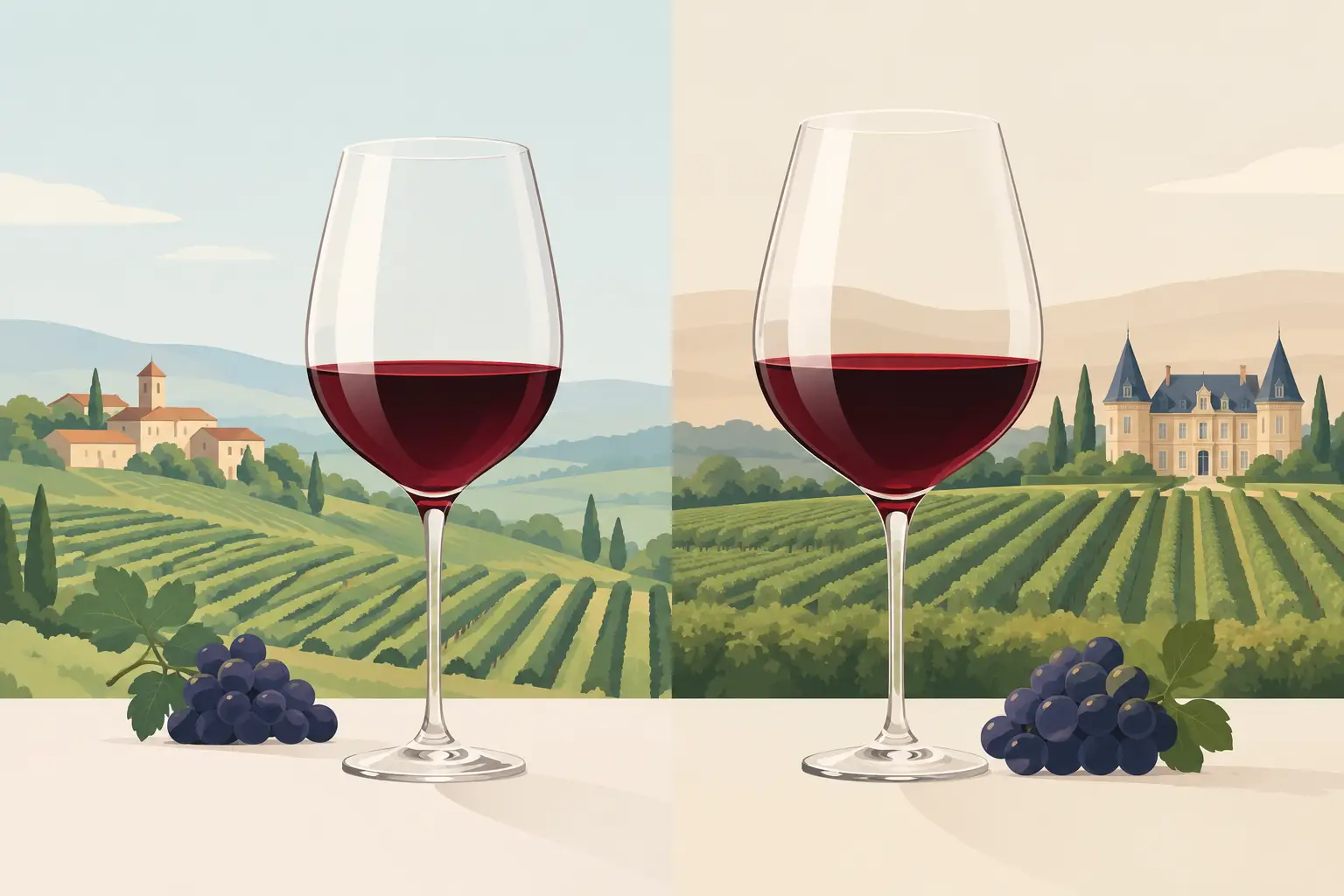
A Burgundy label can look deceptively simple: a village name, a producer, a vintage, and perhaps the words Premier Cru or Grand Cru. Yet premier cru versus grand cru is one of the most consequential distinctions a buyer can make. It affects rarity, price, aging potential, and, most importantly, what is in the glass.
The hierarchy is useful, but it is not a shortcut to guaranteed pleasure. An inspired Premier Cru from a great producer in a strong vintage can be more compelling than a lesser Grand Cru, especially when freshness, value, or near-term drinking is the priority. The most rewarding approach is to understand what the classification tells you, then read it alongside producer, site, vintage, and provenance.
Premier Cru Versus Grand Cru: The Essential Difference
In Burgundy, Grand Cru sits at the summit of the vineyard classification system. These are officially delimited vineyard sites judged to possess exceptional potential, typically capable of yielding wines with greater depth, perfume, structure, and longevity. There are only a little over 30 Grand Cru appellations in Burgundy, and their tiny scale is a major reason the bottles are so scarce.
Premier Cru occupies the tier directly below. A Premier Cru wine also comes from a named, recognized vineyard site, but one classified below Grand Cru. There are hundreds of Premier Cru climats, or precisely defined vineyard parcels, spread across the Côte de Nuits, Côte de Beaune, Chablis, and other parts of Burgundy.
The difference is not merely a marketing flourish. It is rooted in a long assessment of each site’s soils, slope, exposure, drainage, altitude, and historic ability to ripen grapes and produce distinctive wines. Grand Cru sites often combine several favorable conditions in an unusually complete way. Premier Cru sites can be superb, but may have slightly less consistent exposure, more variation within the vineyard, or a profile that is simply less powerful or complete.
Still, classification describes potential, not an automatic quality score. Winemaking decisions, vine age, yields, farming, and the producer’s exact parcel can substantially change the result.
Why Burgundy Makes the Question So Important
Burgundy is the classic home of this debate because its finest wines are often defined by place rather than by estate name. The region’s fragmented ownership means one vineyard may be divided among many growers, each farming and vinifying a small holding differently.
Take a Grand Cru such as Clos de Vougeot. Its broad footprint and many owners mean bottle selection matters enormously. A respected domaine with old vines in a favored section may make a wine of striking refinement, while another bottling can be less precise. Conversely, a tightly held Premier Cru such as Les Amoureuses in Chambolle-Musigny or Les Saint-Georges in Nuits-Saint-Georges may offer a level of aromatic detail and finesse that rivals many Grand Crus.
This is why Burgundy buyers should begin with the producer, then the vineyard classification. A great domaine’s Premier Cru is often a more confident purchase than an unfamiliar name’s Grand Cru. For collectors, that also makes Premier Cru a fertile category for discovering wines before broader demand pushes prices higher.
What Grand Cru Usually Delivers
At its best, Grand Cru Burgundy has an extra dimension rather than simply more weight. In red Burgundy, that may mean a sensational perfume of rose petal, wild strawberry, spice, forest floor, and mineral earth, carried by silky texture and a breathtakingly long finish. In white Burgundy, it may show layered citrus, orchard fruit, hazelnut, crushed stone, and a concentration that continues to reveal itself over a decade or more.
Grand Cru wines are commonly built for patience. Their intensity can be reserved in youth, particularly in structured vintages. A serious cellar allows the fruit, savory complexity, and site character to integrate.
What Premier Cru Does Exceptionally Well
Premier Cru Burgundy often provides the most satisfying balance between pedigree, character, and accessibility. The wines can be highly expressive of their village and vineyard while requiring less financial commitment than Grand Cru. Many also arrive at a more approachable drinking stage sooner, although the best examples can age beautifully.
For a dinner, a Premier Cru can be a particularly intelligent choice. A refined Volnay Premier Cru with roast duck, a mineral Chablis Premier Cru alongside oysters or steamed fish, or a poised Vosne-Romanée Premier Cru with mushroom dishes offers genuine vineyard distinction without requiring a once-in-a-decade occasion.
The Label Tells You Different Things in Different Regions
The terms Premier Cru and Grand Cru are not universal quality grades with identical meaning across France. Their significance changes by region.
In Champagne, Grand Cru and Premier Cru historically refer to the quality ranking of the village where grapes are grown, rather than a specific vineyard parcel. Grand Cru villages include celebrated names such as Ambonnay, Bouzy, Aÿ, and Le Mesnil-sur-Oger. A grower Champagne made entirely from Grand Cru fruit can be remarkable, but the producer’s blending decisions, reserve wines, dosage, and time on lees remain central to style and quality.
In Alsace, Grand Cru denotes one of the region’s named exceptional sites. These wines are often aromatic and site-specific, particularly from Riesling, Gewürztraminer, Pinot Gris, and Muscat. There is no Premier Cru tier in the same formal sense as Burgundy, so the comparison does not translate directly.
In Bordeaux, the language can create even more confusion. “Premier Cru” may appear in historical classifications, most famously the First Growth estates of the 1855 Classification, while Saint-Émilion has its own hierarchy of Premier Grand Cru Classé and Grand Cru Classé. Meanwhile, the broad “Saint-Émilion Grand Cru” designation is an appellation category, not the same as a classified estate. A buyer should never assume that “Grand Cru” on a Bordeaux label means what it means on a Burgundy bottle.
Price, Rarity, and the Value Question
Grand Cru commands a premium for understandable reasons: restricted acreage, lower production, global demand, and a reputation for long-lived excellence. Prestigious names can rise well beyond the price difference implied by quality alone. For a collector seeking benchmark bottles, landmark vintages, or wines with established secondary-market demand, that premium may be justified.
For many drinkers, however, Premier Cru offers the more compelling value proposition. It can deliver vineyard specificity, a respected appellation, and the signature of a leading producer at a fraction of the Grand Cru price. This is especially true when shopping village by village rather than chasing only famous vineyard names.
Vintage also alters the calculation. In a generous, early-drinking vintage, a well-made Premier Cru may give immediate pleasure while a Grand Cru remains closed. In a more classical vintage with bright acidity and firm structure, the Grand Cru may justify patience and cellar space. Bottle size matters too: magnums generally evolve more slowly and can be excellent choices for longer-term storage or celebratory dining.
How to Buy With Confidence
Start by deciding what you want the bottle to do. If you are opening wine for a dinner this year, look for a producer whose Premier Cru style is known for fragrance and approachability, and ask about the vintage’s readiness. If you are building a cellar for ten or more years, Grand Cru may be the appropriate target, provided provenance and storage are impeccable.
Then focus on the details that classifications cannot cover. Consider the producer’s track record, the exact vineyard, the vintage conditions, critic commentary, and the bottle’s source. Critic scores are useful reference points, particularly for comparing wines within the same vintage, but tasting descriptions often reveal more about whether a wine suits your palate. A high-scoring, densely structured Grand Cru is not necessarily the right bottle for someone who favors delicate, floral Pinot Noir.
For gifting, the answer depends on the recipient. A Grand Cru from a revered domaine makes an unmistakable statement for a serious collector. A thoughtfully selected Premier Cru can be more personal for a wine lover who values distinctive terroir and will enjoy opening it sooner. The story of the vineyard, producer, and vintage often makes the gift memorable.
A Better Way to Choose Between Them
Think of Grand Cru as the pursuit of a site at its most ambitious: rare, potentially profound, and often deserving of time. Think of Premier Cru as Burgundy’s great field of opportunity: wines of real pedigree that can be astonishingly beautiful, frequently more versatile at the table, and sometimes the wiser purchase.
The best bottle is not always the highest classification. It is the one with the right provenance, producer, vintage, and moment behind it. For help matching a Premier Cru or Grand Cru to a cellar plan, dinner menu, or special gift, the Crystal Wines team can help turn a celebrated label into a confident choice.


