


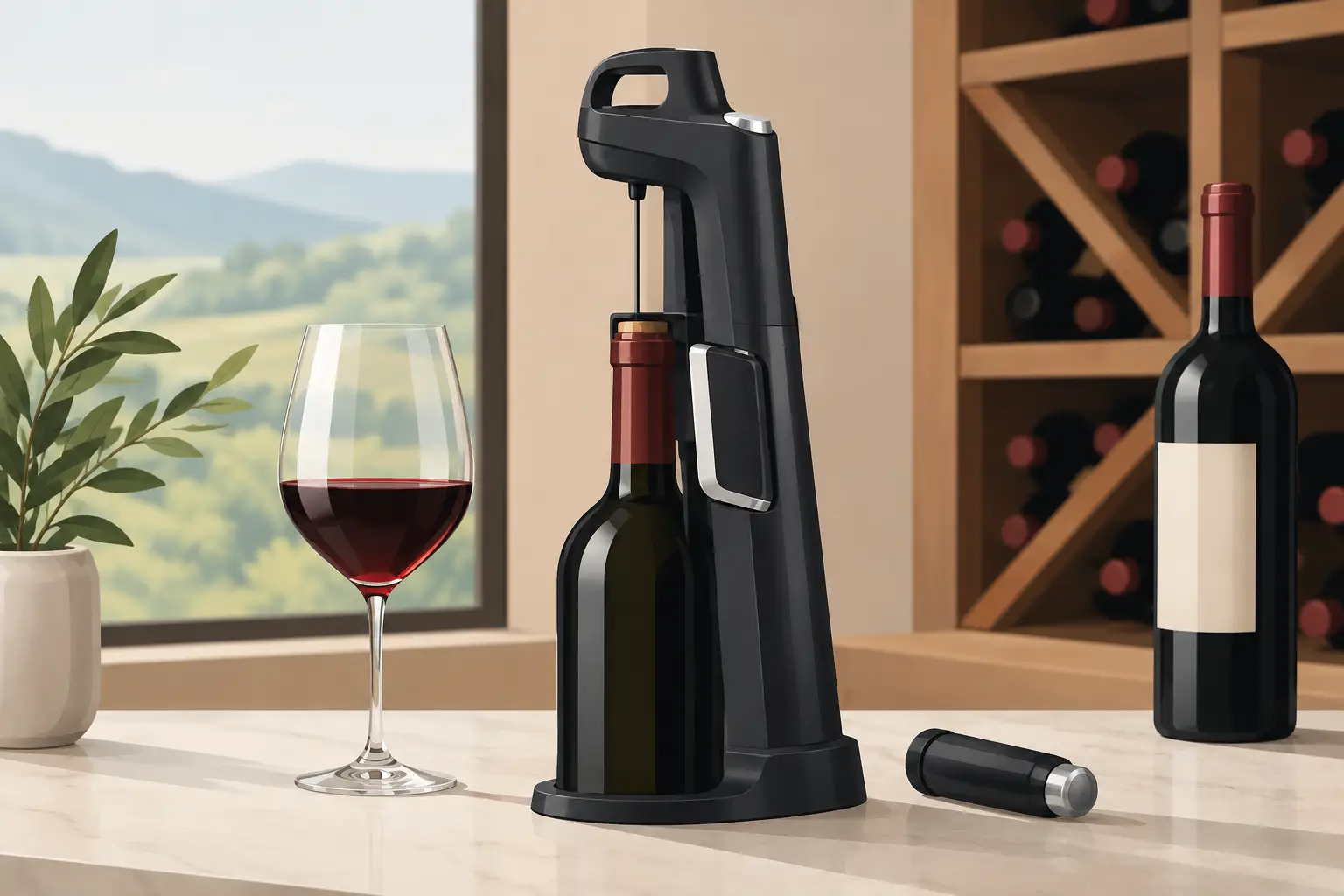
A coveted bottle should not require an occasion large enough to finish it. That is the promise behind this Coravin system review: the ability to pour a measured glass of mature Barolo, classified-growth Bordeaux, or grand cru Burgundy while leaving the remaining wine protected for another evening. For collectors and enthusiastic drinkers alike, it is a compelling proposition. The real question is whether the system performs well enough to justify its place beside a serious cellar.
What the Coravin System Does
The original Coravin Timeless system accesses wine through a natural cork without removing it. A fine needle passes through the closure, argon gas is introduced to create pressure, and wine flows into the glass. Once the needle is removed, a healthy natural cork is designed to reseal itself.
Unlike a conventional preservation stopper, Coravin does not depend on an opened bottle being kept under gas after air has entered. The bottle remains physically sealed throughout the pour. This distinction is why the system appeals particularly to drinkers opening expensive bottles by the glass, rather than simply trying to extend an everyday wine for a few days.
The experience is strikingly close to serving from a freshly opened bottle. There is no theatrical decanting required, no need to commit to 750ml at dinner, and no pressure to rush through a wine that deserves a slower acquaintance. A two-ounce pour can be enough to assess a new vintage, compare appellations, or enjoy a fine bottle with a quiet weekday meal.
Coravin System Review: Where It Excels
Coravin is at its best when the wine has genuine value, whether monetary, sentimental, or educational. Opening a bottle of young Bordeaux solely to check its development can feel extravagant. With Coravin, a collector can follow the wine over several months or years, observing how fruit, tannin, and secondary complexity evolve without sacrificing the entire bottle in one sitting.
It is equally persuasive for households where preferences differ. One person may want a glass of elegant Pinot Noir with roast chicken, while another prefers a structured Cabernet Sauvignon. A Coravin makes that choice practical, particularly when the alternatives are opening multiple bottles or settling for a pairing that only partly suits the meal.
The system also has a serious tasting application. Side-by-side comparison is one of wine’s great pleasures: two vintages from the same estate, village versus premier cru, or left-bank Bordeaux against right-bank Merlot. Being able to pour small, precise samples from several bottles helps make these comparisons possible without unnecessary waste.
For wines sealed with sound natural cork, preservation is the central strength. A bottle accessed and stored correctly can remain in excellent condition for an extended period. That does not mean every bottle should be treated as a laboratory sample. Wine is variable, cork is a natural material, and storage conditions still matter. But for a well-kept bottle, the result is substantially more convincing than traditional vacuum pumps or preservation sprays.
The Trade-Offs to Consider
The purchase price is only part of the commitment. Timeless systems require argon capsules, and regular users should factor replacement capsules into the ongoing cost. The expense is much easier to justify when used on $75, $150, or $500 bottles than on a simple weekday red meant to be enjoyed over two nights.
There is also a modest learning curve. The bottle must be positioned properly, the needle inserted carefully, and the system operated patiently. Pouring is slower than pulling a cork, especially with models that use a finer needle. For some drinkers, that ritual enhances the experience. For others, it can feel like an unnecessary interruption before dinner.
Needle care deserves attention as well. The needle is fine, sharp, and essential to the tool’s performance. It should be kept clean, stored correctly, and handled with the same care one would give a favorite decanter or fine stemware. A blocked or damaged needle can affect the pour and turn an otherwise elegant device into a frustrating one.
Most importantly, Coravin is not universal. The Timeless system is designed for wines under natural cork. It should not be used with screw caps, glass closures, or sparkling wines. Coravin offers separate systems for these needs, including Pivot for compatible bottles fitted with its stopper and a dedicated sparkling-wine preservation system. Those products serve different drinking habits and should not be confused with the long-term appeal of the cork-piercing Timeless range.
Bottle Compatibility Matters More Than Many Buyers Expect
The quality and condition of the cork are central to the Coravin experience. Young wines with long, healthy natural corks are generally ideal candidates. Older bottles call for greater judgment. A fragile cork, a cork showing seepage, or a bottle stored in questionable conditions may not reseal reliably after being pierced.
For mature wine, inspect the closure first. Signs of raised cork, wine staining around the capsule, or an unusually soft cork are reasons to proceed cautiously. In such cases, opening the bottle conventionally may be the wiser decision. A mature bottle of Burgundy or aged Bordeaux often has a delicate equilibrium, and the pleasure of sharing it in full can outweigh the benefit of preservation.
Bottle temperature matters too. Wine should be stored and accessed at a stable temperature, ideally upright for a short period before pouring if it has been resting on its side. This allows any loose sediment to settle and makes the process more controlled. After use, return the bottle to proper cellar conditions rather than leaving it on a warm kitchen counter.
Which Coravin Is Right for Your Drinking Style?
The choice is less about prestige than frequency and purpose. Entry-level Timeless models offer the core proposition: access through natural cork and preservation for future pours. Higher-tier versions tend to improve speed, ergonomics, and precision. A faster-pouring model is attractive for frequent use, while a more basic model may be entirely sufficient for a collector sampling a bottle occasionally.
If screw-cap wines make up most of your drinking, the Pivot system may be more relevant, though it requires replacing the original closure with a Coravin stopper after opening. It is practical for preserving wine over shorter periods, but it does not offer the same unopened-bottle proposition as Timeless.
For Champagne and other sparkling wines, choose the sparkling system rather than attempting to adapt a still-wine tool. Sparkling preservation is a separate challenge because pressure, rather than oxygen alone, defines the wine’s freshness. A proper sparkling stopper can extend the pleasure of an opened bottle, but it is not intended to recreate the exact condition of a newly disgorged Champagne indefinitely.
Is Coravin Worth It for Fine Wine?
For the serious cellar, the answer is often yes, provided it is used selectively. A Coravin earns its value when it changes behavior: when it encourages you to enjoy better wine more often, taste thoughtfully, and stop treating every special bottle as an all-or-nothing commitment.
It is less compelling for drinkers who mostly buy inexpensive wine, regularly finish a bottle at dinner, or favor screw caps and sparkling wine. In those cases, a half-bottle, a smaller pour, or simply sharing with friends may be the more satisfying solution.
At Crystal Wines, the appeal is easy to understand for bottles with personality and aging potential. A Coravin can make it possible to revisit a refined Brunello after a month, compare a pair of Saint-Émilion vintages with dinner guests, or pour one glass from a cherished bottle without asking whether the rest will be finished tomorrow.
The best reason to own one is not to preserve every bottle. It is to give the bottles that matter most the time, attention, and company they deserve.


