


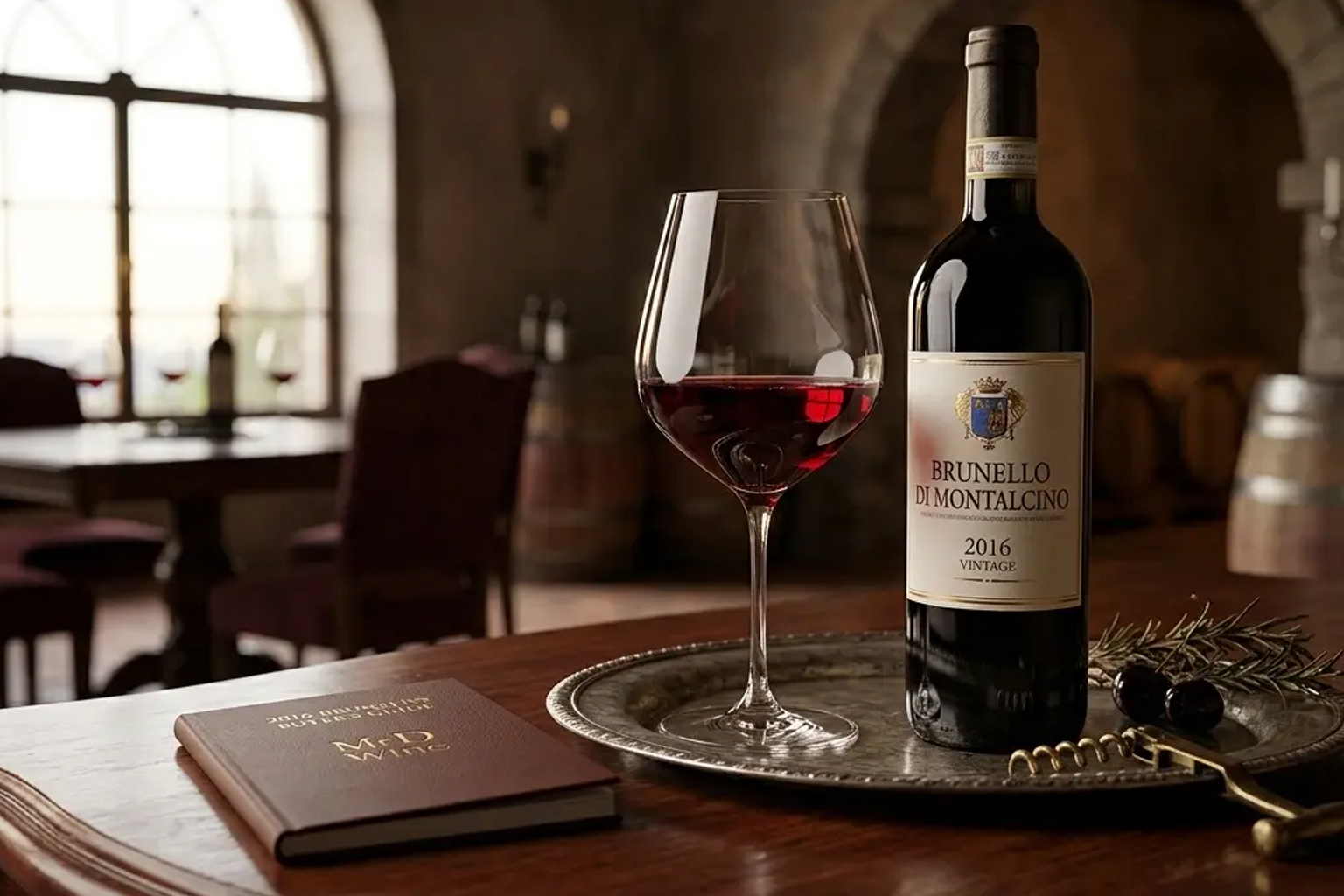
A mature Brunello is one of Italy’s great dinner-table revelations: dried rose, cedar, savory tobacco, balsamic herbs, and hauntingly sweet red cherry, carried by Sangiovese’s unmistakable acidity. The best Brunello vintages for cellaring can evolve for two decades or more, but vintage alone is not a guarantee. Producer style, vineyard position, bottle provenance, and storage determine whether a bottle becomes wonderfully complex or simply grows tired.
For collectors building a considered Italian cellar, Brunello di Montalcino offers an especially compelling balance. The wines have the structure to age, the pedigree to reward careful buying, and enough stylistic range to suit both traditionalists and drinkers who favor a more polished, contemporary expression.
Best Brunello Vintages for Cellaring: The Leading Years
2016: The benchmark for classical longevity
The 2016 Brunellos are widely regarded as a modern benchmark. A long, even growing season gave producers fruit with excellent ripeness, vivid acidity, and firm but refined tannins. At their best, these wines are not merely powerful. They are beautifully proportioned, with dark cherry, wild strawberry, orange peel, earth, and mineral notes that should gain complexity over a very long life.
For top estates, 2016 is a compelling choice for holding 15 to 25 years from release, potentially longer in exceptional cellars. Bottles from high-altitude sites or traditionally minded producers may appear reserved in youth, which is precisely the point. Patience should be rewarded with a sensational perfume and a breathtakingly long finish.
2015: Generous, complete, and broadly appealing
Warm and dry without becoming excessively heavy, 2015 produced Brunellos with generous fruit, supple texture, and ample structure. The best examples possess a sunny core of ripe cherry and plum, tempered by fresh acidity and savory Tuscan character. It is a vintage that has pleased critics and collectors alike because it can deliver both early enjoyment and serious aging potential.
Compared with 2016, 2015 is often more open-knit and immediately charming. That does not make it short-lived. Leading estates should evolve confidently through the late 2030s and beyond, while many well-made bottlings will offer pleasurable drinking sooner. For a cellar intended to serve both formal dinners and future milestones, 2015 is an intelligent allocation.
2019: A rising star with poise and energy
The 2019 vintage is increasingly recognized for its balance, aromatic freshness, and finely drawn tannic structure. It followed a season with warm periods but avoided the blunt richness that can make some hot years feel less detailed. The leading wines have bright red-fruit definition, floral lift, and the kind of acidity that makes a collector take notice.
Most 2019 Brunellos remain young. Their trajectory will become clearer with time, but the strongest examples have the balance to cellar for 15 to 20 years or more. This is a particularly attractive vintage for buyers who want to acquire recently released wines with a long runway ahead of them.
2010: A proven classic
A decade and a half after harvest, 2010 has earned its place among the finest modern Brunello vintages. The wines combined concentration, freshness, and classic Sangiovese structure, and top bottles are now beginning to show the secondary notes that make mature Brunello so captivating.
A well-stored 2010 from a respected producer can be enjoyed now with a substantial decant, yet there is no need to rush the best examples. Expect evolving notes of leather, dried flowers, forest floor, tea leaf, and spice alongside lingering red fruit. It is an excellent vintage for collectors who want to experience mature character without waiting another decade.
2006 and 2004: Mature-vintage opportunities
For buyers seeking a more developed Brunello, 2006 and 2004 deserve attention, provided provenance is impeccable. The structured 2006s can still have considerable life, particularly from estates known for concentration and traditional élevage. Their tannins may remain assertive, but bottle age has brought savory complexity and greater harmony.
The 2004s are generally more graceful and evolved. Fine bottles can be glorious at table, showing silky texture and autumnal detail rather than youthful force. These are not years to buy blindly. A pristine bottle, ideally with documented storage history, matters more than a famous vintage reputation once Brunello reaches this stage of maturity.
Vintages That Depend More Heavily on Producer
Not every worthwhile Brunello comes from a universally celebrated year. In fact, some of the most satisfying cellar purchases are made in less obvious vintages, when meticulous estates separate themselves from the pack.
The 2013s often show freshness, perfume, and a classical line that will appeal to lovers of restrained Sangiovese. The best are likely to age very well, though the wines can be less generous than 2015 or 2019. The warm 2012s can be seductive and ready earlier, especially from cooler sites, but they should be selected producer by producer for long-term storage.
The 2017s were shaped by heat and drought. They can be rich, expressive, and enjoyable in their youth, yet they are generally less dependable choices for multi-decade cellaring than 2016 or 2019. The same measured approach applies to 2020. Early impressions suggest charming, approachable wines in many cases, but collectors should prioritize estates with cooler vineyards, careful extraction, and a record of aging gracefully in warmer years.
Producer Matters as Much as the Year
Montalcino is not a single landscape. Altitude, exposure, soils, and proximity to the Mediterranean all influence the finished wine. Northern and higher-elevation sites often preserve more acidity and aromatic lift, while warmer southern sectors can produce broader, more powerful Brunellos. Neither style is inherently superior. The decision should reflect how you like to drink and how long you intend to wait.
For classically structured, long-lived bottlings, collectors often look to estates such as Biondi-Santi, Il Poggione, Fuligni, Salvioni, Valdicava, and Le Ragnaie. Producers including Casanova di Neri, Argiano, Altesino, Caparzo, and Poggio di Sotto also offer distinctive expressions across different sites and winemaking philosophies. Within any portfolio, a vineyard selection, Riserva, or single-vineyard wine may have greater concentration and longevity, but a standard Brunello from an excellent estate can be every bit as satisfying.
Critic scores are useful signals, especially when comparing many wines, but tasting notes reveal more about style. Look for references to freshness, tension, mineral detail, aromatic complexity, and fine tannins if your priority is extended cellaring. Descriptions centered only on ripeness, toast, or immediate richness may point to a wine that will drink beautifully earlier rather than improve indefinitely.
How Long Should You Cellar Brunello?
A quality Brunello usually needs at least eight to 10 years from harvest before it begins to soften into its fuller aromatic range. In strong vintages, a more realistic window for top producers is 12 to 20 years, with Riservas and exceptional bottles capable of going well beyond that. The wine’s five-year minimum aging requirement before release should not be confused with full maturity. Many bottles are technically ready for sale long before they are ready to show their best.
If you buy several bottles, open one at around 10 years to understand its evolution, then revisit at five-year intervals. This practical approach is preferable to relying on a single published drinking window. Your storage conditions, preferred maturity level, and the individual bottle’s development will always have the final word.
Storage Is Part of the Purchase
In Singapore’s heat and humidity, Brunello should be kept in a temperature-controlled wine fridge or professional storage facility, ideally around 55°F with minimal vibration and light. Consistency is more valuable than chasing a perfect number. Repeated heat exposure can accelerate aging, flatten fruit, and compromise the very detail that made a cellar-worthy vintage worth buying.
Buy from a specialist merchant that takes provenance seriously, particularly for older bottles and original-case purchases. Check fill levels, capsule condition, bottle format, and storage history where available. Magnums are especially attractive for major vintages because they typically age more slowly and make a memorable centerpiece for a celebratory table.
When the moment comes to open a mature Brunello, stand the bottle upright for a day, decant gently only if sediment requires it, and avoid treating every older wine as though it needs hours of air. A 2016 may welcome a broad decant; an elegant 2004 may be more expressive when poured carefully and followed over the course of dinner. Build a cellar around 2016, 2015, and 2019, then reserve a few mature 2010s or 2004s for the evenings when waiting is no longer part of the pleasure.


