


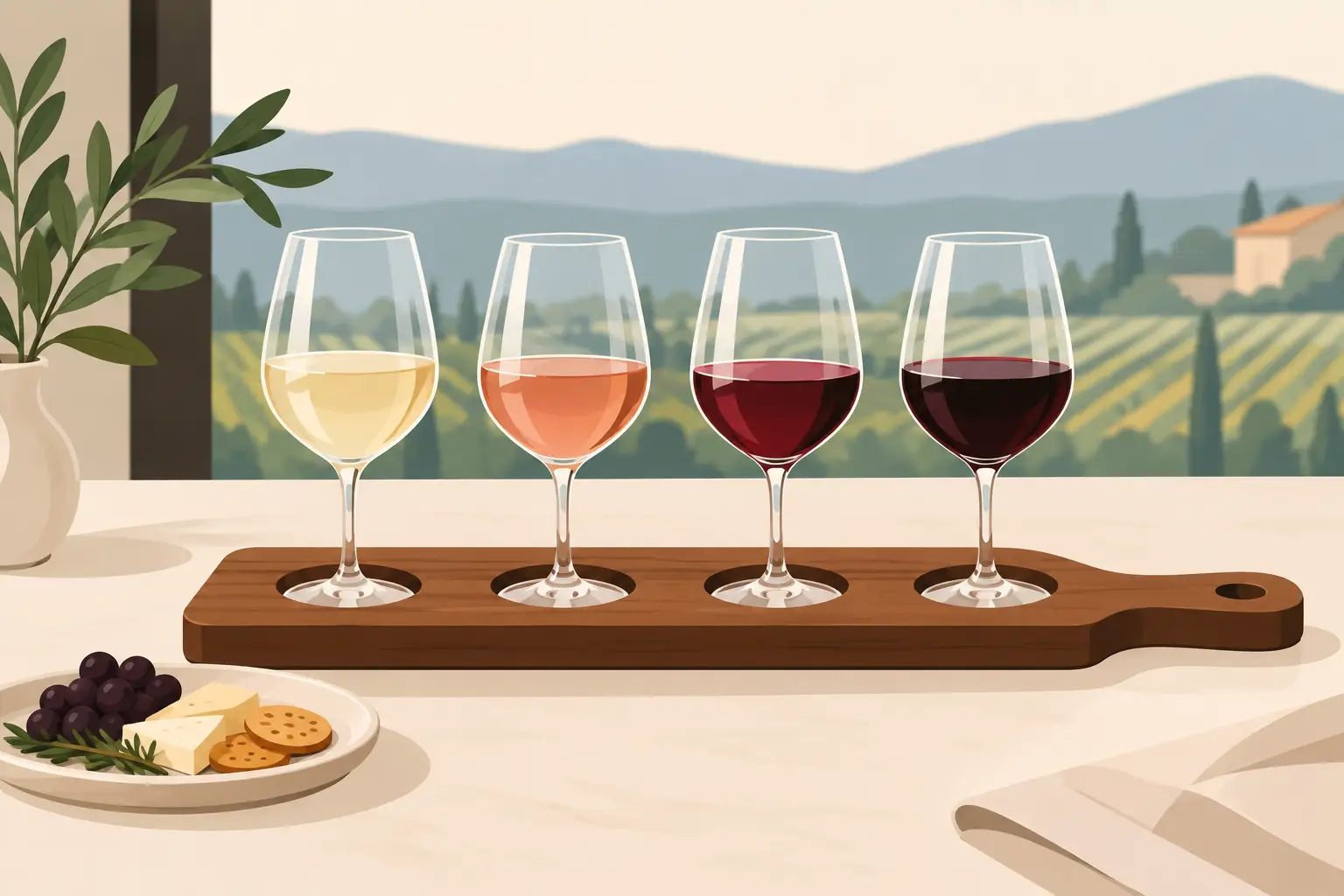
A memorable tasting is not simply three bottles poured side by side. The best wine flight menu examples give guests a clear reason to compare: one grape across different places, one region across several styles, or a progression that makes a dinner feel more considered. For a relaxed evening at home or a more formal wine-focused gathering, the menu should make discovery feel effortless while allowing each bottle its moment.
A useful flight usually contains three wines. This is enough contrast to prompt conversation without tiring the palate or leaving too many unfinished glasses. Four can work for an educational tasting, especially when pours are modest, but more than that is best reserved for a guided event with food, water, and plenty of time.
What Makes a Wine Flight Menu Work
Begin with a question rather than a price point: what do you want guests to taste and understand? A menu built around Champagne, for example, can reveal the difference between a brisk non-vintage Brut, a richer Blanc de Blancs, and a mature vintage cuvée. A menu built around Cabernet Sauvignon can show how dramatically the grape changes between Bordeaux, Napa Valley, and Coonawarra.
Serve wines from lightest to fullest, driest to sweetest, and youngest to oldest when styles are otherwise similar. Sparkling wines generally come first, followed by whites, lighter reds, structured reds, and finally sweet or fortified wines. This sequence protects the more delicate aromas and makes the flight feel intentional rather than random.
For a three-wine flight, plan on 2 to 2.5 ounces per guest of each bottle. That gives everyone enough wine to revisit a favorite after the initial comparison. Chilled water, plain bread or neutral crackers, and simple note cards are worthwhile additions. Strongly flavored snacks can wait until the food-pairing portion of the evening.
8 Wine Flight Menu Examples for Different Occasions
1. Champagne by Style
Pour a non-vintage Brut, a Blanc de Blancs, and a vintage Champagne. The first introduces the house style and refreshing energy that make Champagne so versatile at the table. The Blanc de Blancs, made predominantly or entirely from Chardonnay, often brings more citrus, white flowers, chalk, and finesse. A vintage bottling can offer deeper toast, hazelnut, and pastry notes, with a more expansive finish.
This is an elegant aperitif flight for a birthday dinner, a corporate gathering, or a small celebration. Serve with oysters, chilled crab, gougères, or potato chips with crème fraîche. The humble chip is not a gimmick here: its salt and texture flatter Champagne beautifully.
2. Chardonnay from Three Classic Regions
Set Burgundy against California and Australia with three Chardonnays of comparable quality. A white Burgundy from Chablis or the Côte de Beaune may show citrus, stone fruit, and mineral drive, depending on appellation and élevage. A California example often offers riper orchard fruit and broader texture, while Margaret River or Adelaide Hills can bring a bright middle ground of fruit purity, acidity, and subtle oak.
The lesson is not that one region is superior. It is how climate, harvest decisions, and oak shape the same grape. Roast chicken, seared scallops, or lobster pasta suit this flight, though a lighter Chablis may need its own first course before the richer bottles appear.
3. Pinot Noir: Old World and New World
Choose a village-level Burgundy, an Oregon Pinot Noir, and a New Zealand Pinot Noir from Central Otago or Martinborough. Burgundy can be nuanced and savory, with red cherry, rose petal, earth, and fine-boned structure. Oregon often offers fragrant red fruit and freshness, while Central Otago can be darker-fruited, silkier, and more immediately expressive.
This is one of the most sociable wine flights because every glass is recognizably Pinot Noir, yet the differences are easy to discuss. Pair it with duck breast, mushroom risotto, roast quail, or salmon with a lightly earthy sauce. Avoid heavy spice or sweetness, which can obscure the grape’s perfume.
4. A Bordeaux Bank Comparison
For guests ready to move beyond labels, pour a Left Bank Bordeaux, a Right Bank Saint-Émilion or Pomerol, and a Bordeaux-inspired New World blend. Cabernet Sauvignon typically drives the Left Bank profile: blackcurrant, cedar, graphite, and firm tannin. Merlot and Cabernet Franc play more prominent roles on the Right Bank, often producing a plusher texture, plum fruit, and floral lift.
The third wine provides perspective. A Napa Valley Cabernet-based blend, for instance, may show more generous fruit and alcohol, while an Australian blend might bring eucalyptus and savory spice. Serve this flight with prime rib, lamb chops, or a well-marbled steak. Decant young, structured bottles in advance, especially when the menu includes a recent vintage.
5. Barolo, Brunello, and Etna Rosso
Italy offers a superb red-wine flight for guests who value fragrance and food compatibility over sheer weight. Start with Etna Rosso, whose Nerello Mascalese can be lifted, volcanic, and finely tannic. Move to Brunello di Montalcino for Sangiovese’s sour cherry, dried herb, and leather notes. Finish with Barolo, where Nebbiolo delivers rose, tar, red fruit, and formidable structure.
These wines improve with food, and the menu should reflect that. Offer porcini pasta, grilled lamb, aged Parmigiano Reggiano, or braised beef. Barolo is usually the most tannic wine in the set, but bottle age can change the order. A mature Brunello may be more delicate than a youthful Etna Rosso, so taste before deciding how to pour.
6. Riesling from Dry to Sweet
A Riesling flight is among the clearest demonstrations of how sweetness, acidity, and origin can coexist. Begin with a dry Riesling from Alsace, Australia, or Germany. Follow with an off-dry German Kabinett, then finish with a late-harvest or Beerenauslese-style wine, depending on availability and the occasion.
The crucial detail is balance. Great Riesling retains enough acidity to keep even a sweet wine vivid rather than heavy. This menu works exceptionally well with Southeast Asian food, making it especially useful for Singapore entertaining: think chili crab, aromatic roast duck, Thai green curry, or spicy prawn dishes. Serve the sweeter wine in a smaller pour and slightly cooler than the dry bottling.
7. Rosé Beyond the Poolside
A rosé flight can be surprisingly serious when the wines are selected by structure rather than color alone. Compare a pale, dry Provençal rosé with a fuller Bandol rosé and a darker, fruit-forward example from Tavel or a quality New World producer. Guests will see that rosé ranges from delicate citrus and herbs to savory, textured wines capable of carrying a meal.
This is a natural warm-weather menu, but it need not be casual. Pair it with grilled prawns, Niçoise-inspired platters, charcuterie, or saffron seafood rice. Keep bottles cold but not ice-cold, particularly the more structured example, so its aromas are not muted.
8. A Cellar-to-Table Vintage Flight
For collectors and serious enthusiasts, choose three vintages of the same producer, appellation, or grape. This could be three Bordeaux vintages from one château, three Brunellos from a respected estate, or three Napa Cabernets from the same vineyard. The objective is to taste vintage conditions and bottle evolution, not merely prestige.
Ideally, include one youthful wine, one wine entering its drinking window, and one mature bottle. The youngest may show primary fruit and grip; the middle vintage often has the most complete balance; the oldest can reveal tobacco, truffle, dried flowers, and a breathtakingly long finish. Provenance matters greatly here. Bottles should have been properly stored, and mature corks deserve careful opening and a gentle decant only if sediment requires it.
How to Present the Menu with Confidence
Print or write a short card for each wine with producer, vintage, region, grape variety, and one sentence on why it belongs in the flight. Avoid giving guests a long critic review before they taste. Scores and professional commentary are valuable purchasing tools, but a blind first sip often produces a more honest reaction.
If the evening includes a premium bottle, place it within a flight that gives it context. A classified-growth Bordeaux is more compelling beside two thoughtful comparisons than as a solitary trophy pour. Likewise, a modest but well-made regional wine can become a revelation when it illustrates a place or grape with clarity.
When selecting bottles, Crystal Wines can help shape a flight around a favorite appellation, dinner menu, collector budget, or specific vintage. The most successful lineup is rarely the most expensive one. It is the one where every glass has a role, every guest has something to notice, and the final pour leaves the table talking.


