


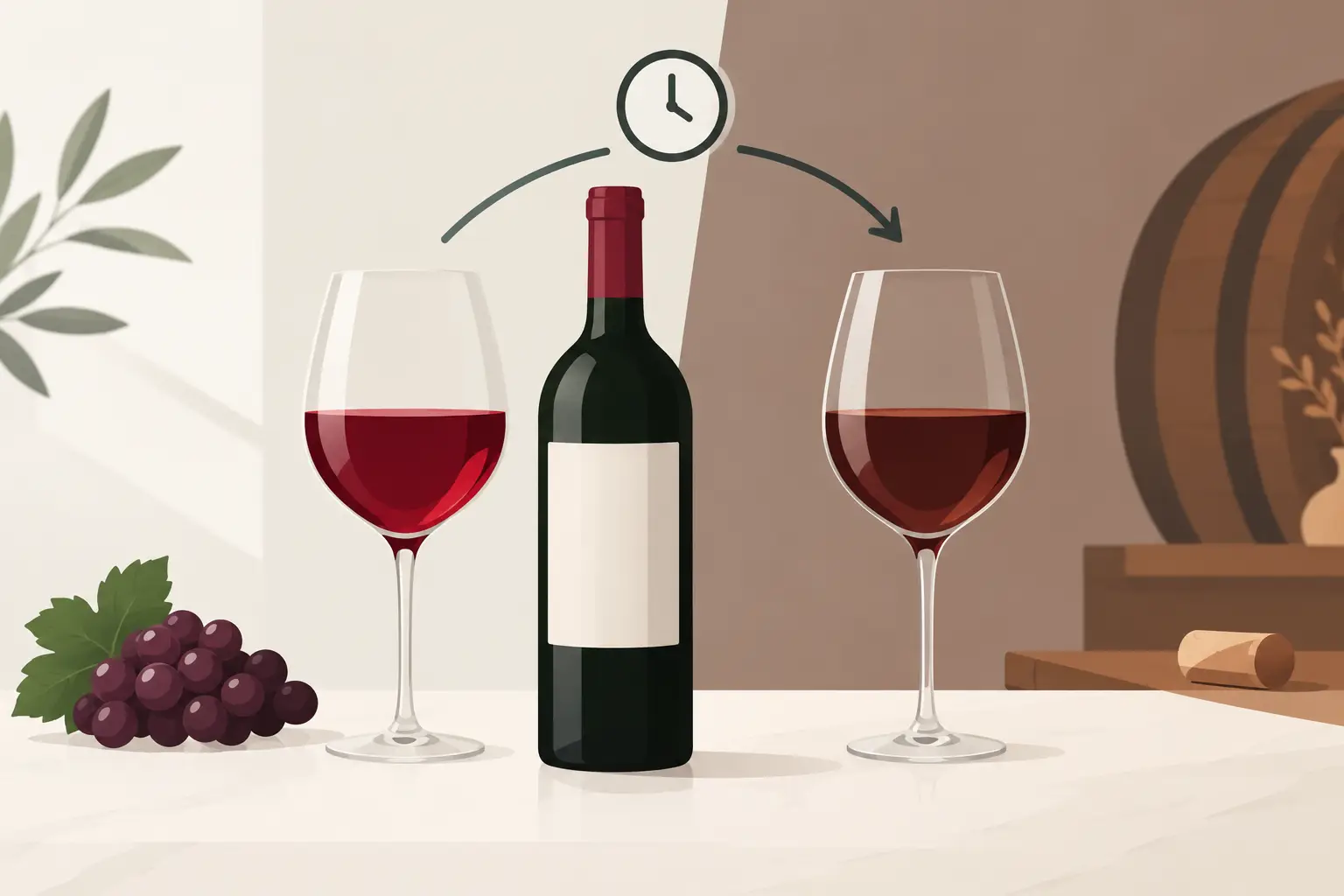
A bottle of mature Bordeaux can spend decades developing cedar, tobacco, and savory complexity in a cool cellar. Once its cork is pulled, however, the clock changes. Can wine age after opening? Not in the beneficial, slow-moving sense that collectors mean by aging. An opened wine evolves quickly because oxygen begins to reshape its aromas, texture, and color.
That change is not always unwelcome. A young, structured red can become more expressive over several hours, and certain wines are more compelling on day two. But this is a short period of aeration, not further maturation. Understanding the distinction helps you decide whether to decant a special bottle, preserve a half-finished one, or enjoy it before its finest details fade.
Can Wine Age After Opening, or Does It Oxidize?
Bottle aging is a gradual process that occurs with only minute oxygen exchange through the closure. Over years, tannins polymerize and soften, primary fruit can give way to truffle, dried rose, leather, forest floor, and spice, and the wine finds a more integrated shape. Temperature, light, vibration, closure quality, and storage history all influence that journey.
After opening, oxygen enters at a far greater rate. At first, this can be useful. Aromas that were compressed in bottle begin to lift, reduction may blow off, and firm young tannins can seem less severe. This is why a youthful Barolo, Brunello di Montalcino, or classically built Cabernet Sauvignon may show better after a measured decant.
Then the balance tips. Oxygen gradually strips fresh fruit character, dulls aromatic precision, and pushes the wine toward bruised apple, nutty, caramelized, or vinegary notes. Red wines can shift from ruby toward brown at the rim, while whites lose brightness and freshness. The wine is not becoming more mature in a cellar-worthy way. It is moving through a brief open phase toward decline.
The rate depends on the wine and the bottle. A powerful red with concentration, tannin, acidity, and a high fill level may remain attractive for several days. A delicate old Burgundy can be breathtaking for an hour and fragile by the following afternoon. There is no single rule that honors every producer, vintage, or style.
The Difference Between Air and Time
It is useful to separate three experiences often described as “opening up.” First is aeration: exposure to air for minutes or hours. Second is post-opening evolution: the changes that occur over one to several days under preservation. Third is bottle age: development over years in sound storage.
A newly released Saint-Émilion with ripe fruit and polished oak may become more generous after an hour in a decanter. A traditionally styled Barolo may reveal its sensational perfume more clearly on day two, when its tannin and acidity have settled into the fruit. Neither result means the wine has aged. It means its components have rearranged temporarily in the presence of oxygen.
Older wines require more restraint. A mature classified-growth Bordeaux or fine Burgundy has already completed much of the development that young wines need time to achieve. Decant only if there is sediment or if the wine initially seems closed, and taste regularly. For some mature bottles, opening immediately before pouring is the most respectful approach. Their haunting bouquet can disappear faster than their structure suggests.
How Long Does Open Wine Last?
Storage times are guidelines, not guarantees. A wine’s acidity, tannin, sweetness, alcohol, and winemaking all matter, as does how much wine remains in the bottle. A nearly full bottle has less oxygen in its headspace than one with a single glass left.
Red wines
Most quality still reds are enjoyable for three to five days when recorked and refrigerated. Chilling may feel counterintuitive, but it slows oxidation; simply take the bottle out 20 to 30 minutes before serving. Structured reds such as Cabernet Sauvignon, Nebbiolo, Syrah, and Sangiovese often hold particularly well. Light, aromatic reds such as Pinot Noir and Beaujolais are more variable, though a well-made example with good acidity can remain vivid for two or three days.
For collectible, mature reds, think in hours rather than days. A bottle at its plateau of maturity may retain its core on day two, yet lose the lifted perfume and silky detail that made it exceptional. Pour smaller servings, return the closure promptly, and revisit it with curiosity rather than expectation.
White, rosé, and orange wines
Crisp dry whites and rosés generally keep for three to five days in the refrigerator. Sauvignon Blanc, Riesling, Albariño, and dry Chenin Blanc can be quite resilient because of their acidity. Richer whites, including barrel-fermented Chardonnay, may become less vibrant sooner, although their texture can remain appealing for several days.
Orange wines vary widely. Their skin contact may lend tannin and phenolic grip, which can make them surprisingly stable after opening. As with any wine, taste rather than relying only on the calendar.
Sparkling wine
Champagne and other sparkling wines are most exciting on the day they are opened. A proper sparkling-wine stopper can preserve a pleasing bead into the next day, especially for a younger, freshly disgorged bottle. By day two or three, the mousse will usually be softer and the palate broader. That can still be enjoyable with food, but it is a different experience from the brisk, precise first pour.
Never rely on a spoon in the neck. It does not meaningfully preserve carbonation. Use a stopper designed to seal under pressure, and refrigerate the bottle upright.
Sweet and fortified wines
Sweet wines often outlast dry wines because sugar offers some protection. Late-harvest wines and Sauternes may be enjoyable for one to two weeks when well chilled and sealed. Fortified wines can last longer still, though styles differ. Ruby Port may hold for several weeks, while a mature Vintage Port is more delicate once opened and is best enjoyed over a few days. Madeira is an outlier: its oxidative style and remarkable stability can allow it to remain compelling for months.
Preserving an Open Bottle Properly
The simplest routine is also the most effective: reseal the bottle, refrigerate it, and minimize oxygen exposure. Refrigeration is valuable for red wine as well as white because lower temperatures slow chemical reactions. Do not leave a prized bottle on a warm kitchen counter, near sunlight, or beside the stove.
If you expect to save wine regularly, preservation tools can extend its useful life. A vacuum pump removes some air from the bottle, though it cannot create a perfect vacuum and may be less suitable for very delicate older wines. Inert-gas systems, which replace oxygen with argon or a similar neutral gas, are generally gentler and more effective for preserving still wine. For a special bottle, decanting the remaining wine into a smaller, clean bottle can also help by reducing the air gap.
Avoid returning leftover wine from glasses to the bottle. It may introduce food residue, water, or other contaminants. If the wine will not be worth drinking tomorrow, it can still earn a place in cooking, provided it has not become sharply vinegary.
When an Open Wine Is Better the Next Day
Some wines genuinely reward patience. Young reds with serious tannin and dense fruit can become more harmonious overnight. High-acid whites may show broader texture and more mineral nuance the next day. Even a firmly wound Champagne can trade some mousse for a more vinous, food-friendly character after a night in the refrigerator.
This is especially true when the bottle has been preserved well and the starting wine had the concentration to spare. The trade-off is freshness. If day-one aromatics were all citrus blossom, crushed berries, and vivid spice, day two may offer more integration but less lift.
The best approach is to taste deliberately. Pour a small glass when the bottle is first opened, note what you see and smell, then revisit it over the next few days. A fine wine does not need to be finished in one sitting, but it does deserve attention while its character is still at its most expressive. For help selecting bottles that suit both an immediate dinner and a leisurely second pour, the team at Crystal Wines can offer recommendations by style, vintage, and occasion.


