


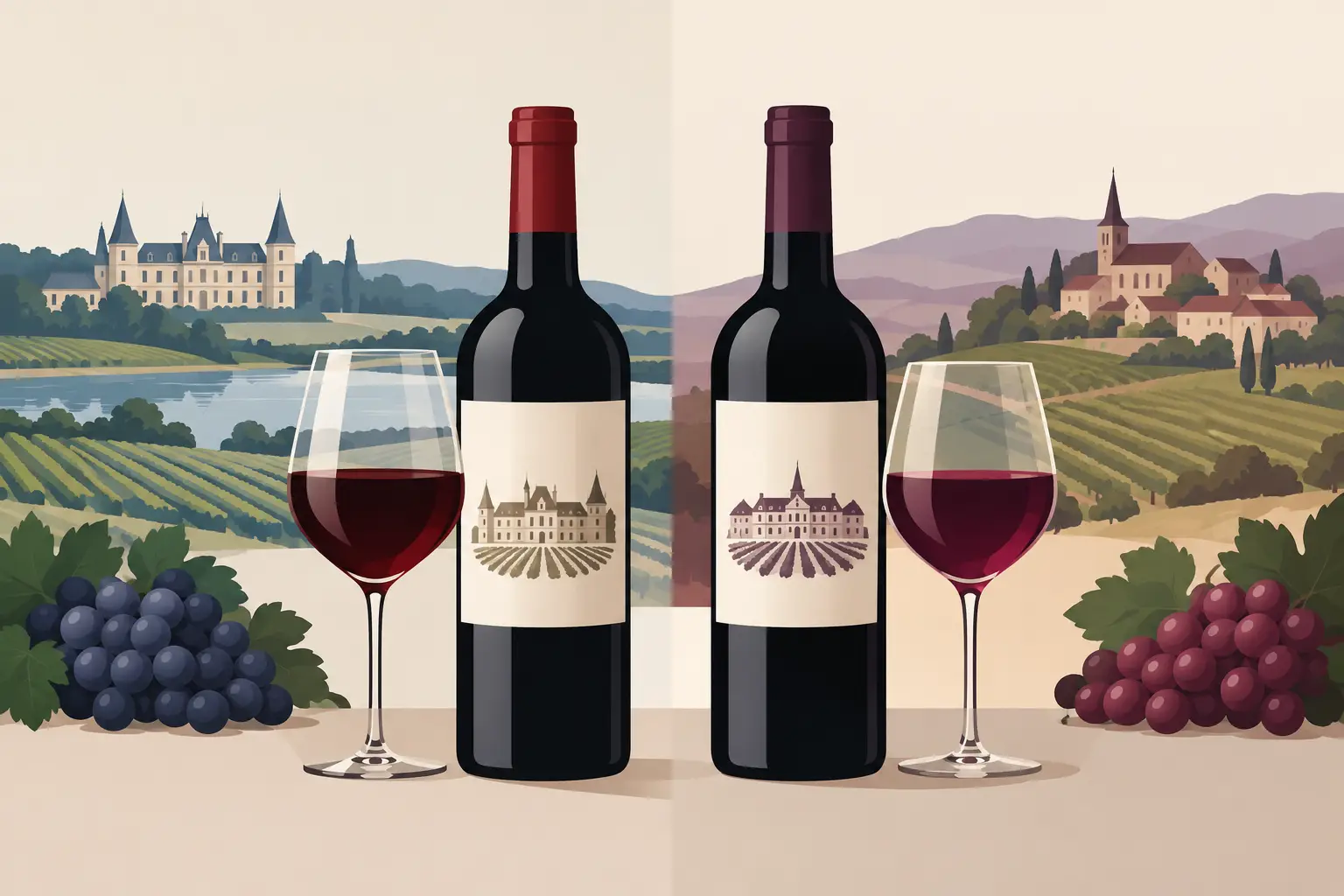
A collector can learn a great deal from the shape of an empty wooden case. Bordeaux cases often speak of continuity: a château, a classified hierarchy, a vintage, and a disciplined buying plan. Burgundy cartons tell a more elusive story, where a single vineyard, parcel, and producer can change the conversation entirely. Bordeaux versus Burgundy collecting is not a contest with one winner. It is a choice between two profoundly different ways of building a cellar – and many of the most rewarding collections make room for both.
For the serious buyer, the distinction matters beyond reputation. It affects how you assess provenance, allocate a budget, choose bottle formats, plan drinking windows, and decide whether a wine is intended for a landmark dinner or decades of patient aging.
Bordeaux versus Burgundy collecting: the central difference
Bordeaux is collected through a framework of estates, appellations, classifications, and vintages. The leading names of Pauillac, Saint-Julien, Margaux, Saint-Estèphe, Pessac-Léognan, Saint-Émilion, and Pomerol have long-established identities. A collector may follow Château Lafite Rothschild or Château Montrose across vintages, compare Left Bank Cabernet Sauvignon structure with the more Merlot-led character of the Right Bank, and build depth with a clear sense of relative standing.
Burgundy is more fragmented, and that fragmentation is part of its allure. Here, the vineyard can matter as much as the domaine. A bottle of Vosne-Romanée Premier Cru, Chambolle-Musigny, or Corton-Charlemagne is not simply a regional expression. It is an interpretation of a specific site by a particular grower, often from very limited holdings. Two producers farming neighboring parcels in the same grand cru may make wines with strikingly different perfume, texture, and aging profiles.
This makes Bordeaux easier to systematize and Burgundy more thrillingly granular. Bordeaux rewards collectors who enjoy tracking vintages and château performance. Burgundy appeals to those who become captivated by terroir, producer style, and the sensational perfume Pinot Noir can deliver when a great site meets a precise hand in the cellar.
Supply, scarcity, and price discipline
The most practical contrast is supply. The major Bordeaux estates generally release meaningful quantities, even if demand for the first growths and leading Right Bank properties remains intense. This gives collectors multiple paths into an appellation or producer. If a blue-chip château is beyond the planned budget, a strong vintage from an excellent classed-growth neighbor may still offer pedigree, structure, and a long future.
Fine Burgundy is often scarce at every level. A coveted domaine may produce only a modest number of bottles from a premier cru, while grand cru allocations can be exceptionally tight. Demand has broadened internationally, and mature bottles from sought-after producers are not easily replaced once consumed. The cost of entry can therefore rise quickly, particularly for benchmark labels from Côte de Nuits.
Scarcity alone does not make a wine collectible. A collector should resist buying Burgundy merely because it is difficult to find. The better question is whether the producer has a convincing track record, whether the vineyard merits attention, whether the vintage suits the wine, and whether the bottle is offered with reassuring provenance. The same discipline applies to Bordeaux, where a famous label is not automatically the most satisfying purchase in every year.
A balanced budget often favors Bordeaux for cellar depth and Burgundy for focused discovery. Instead of chasing a single celebrated Burgundy bottle, consider acquiring a small group from one trusted producer across village, premier cru, and grand cru levels when available. For Bordeaux, a vertical of a favored estate or a selection across appellations can reveal how vintage conditions shape Cabernet Sauvignon, Merlot, and Cabernet Franc.
Aging curves are not identical
Great Bordeaux is famously built for time. In youth, top Left Bank wines can be reserved, with dark cassis, graphite, cedar, firm tannin, and fresh acidity held in a compact frame. With bottle age, they often gain tobacco, truffle, forest floor, and a refined, savory complexity. The finest examples can evolve beautifully for several decades, particularly in large formats.
Burgundy can age just as impressively, but its trajectory is less uniform. The best reds may begin with red and dark cherry fruit, rose petal, Asian spice, tea leaf, and earth, then move toward hauntingly complex secondary notes. Yet Pinot Noir’s structure is not always obvious on release. A wine that feels silkier than young Bordeaux may still need ten, fifteen, or more years to show its full dimension.
White Burgundy deserves its own collecting strategy. Fine Côte de Beaune Chardonnay can be captivating early for its citrus, hazelnut, flint, and creamy texture, while the greatest examples from Meursault, Puligny-Montrachet, and Chassagne-Montrachet develop breathtaking depth over time. Because white Burgundy has its own vintage and bottle-variation considerations, provenance and storage history are especially important.
The useful rule is not that Bordeaux must be aged and Burgundy can be drunk young. Both regions offer wines for near-term enjoyment and long cellaring. Instead, buy with intended occasions in mind. Keep approachable bottles for dinners and spontaneous celebrations, while allowing your most structured Bordeaux and site-specific Burgundy the quiet time they deserve.
Provenance is the collector’s real insurance
For both regions, a pristine bottle is more valuable than a famous name with an uncertain past. Fine wine has spent years, sometimes decades, outside the producer’s cellar. Storage temperature, humidity, transport, fill level, label condition, capsule integrity, and ownership history all influence confidence.
Original wooden cases, professional storage, and clear sourcing become increasingly meaningful for mature wines and investment-minded purchases. This is particularly relevant in Singapore, where heat and humidity make reliable temperature-controlled storage non-negotiable. A bottle that has traveled poorly can disappoint regardless of its critic score or pedigree.
Inspect the details before adding mature stock: confirm the exact vintage, bottle size, condition description, and whether the wine is offered in original packaging. For newer releases, look for a merchant with direct relationships, established allocation channels, and the knowledge to explain where a wine sits in a producer’s range. At Crystal Wines, that conversation can happen with a specialist rather than a generic checkout page.
Build a collection that you will actually open
Collectors sometimes treat Bordeaux as the sensible acquisition and Burgundy as the emotional one. There is some truth in that shorthand, but it can lead to a cellar that feels more like inventory than pleasure. The most satisfying collections reflect how their owners eat, entertain, and celebrate.
Bordeaux is a natural companion for roast lamb, beef, game, and richly flavored Chinese dishes with braised or roasted meats. Mature claret can bring extraordinary grace to a dinner table, especially when served in magnum for a larger gathering. Burgundy red is remarkably versatile with duck, mushrooms, pork, tuna, and dishes shaped by umami rather than sheer weight. Fine white Burgundy can elevate butter-poached seafood, roast chicken, and dishes with delicate cream or nutty notes.
For an emerging collector, a practical starting point is to choose two or three Bordeaux estates across different appellations and one or two Burgundy producers whose style genuinely appeals. Buy more than one bottle when the budget permits. One can be opened in its youth, another after several years, and a third saved for the moment when the wine reaches a more complete expression. That small act of comparison teaches more than a shelf filled with isolated trophies.
Critic scores help, but context decides
Scores from respected critics can be valuable reference points, particularly when comparing vintages or identifying wines that have received broad professional acclaim. They should support, not replace, judgment. A 97-point wine from a powerful, concentrated vintage may be magnificent but wrong for someone seeking fragrance and early accessibility. Conversely, a lower-priced, highly rated village Burgundy may offer more immediate pleasure than an expensive grand cru that requires another decade in the cellar.
Read scores alongside tasting notes, vintage character, producer reputation, and drinking windows. Ask whether the wine fills a missing role in your cellar. Is it a bottle for a 50th birthday, a festive dinner, a gift for a discerning client, or a reference point for understanding a celebrated vineyard? Collecting becomes more confident when every purchase has a purpose.
A great cellar need not declare allegiance to one region. Let Bordeaux provide its stately architecture and dependable longevity; let Burgundy bring its fine-boned detail, rarity, and unforgettable aromatics. Then open the bottles often enough to remember why you began collecting in the first place.


