


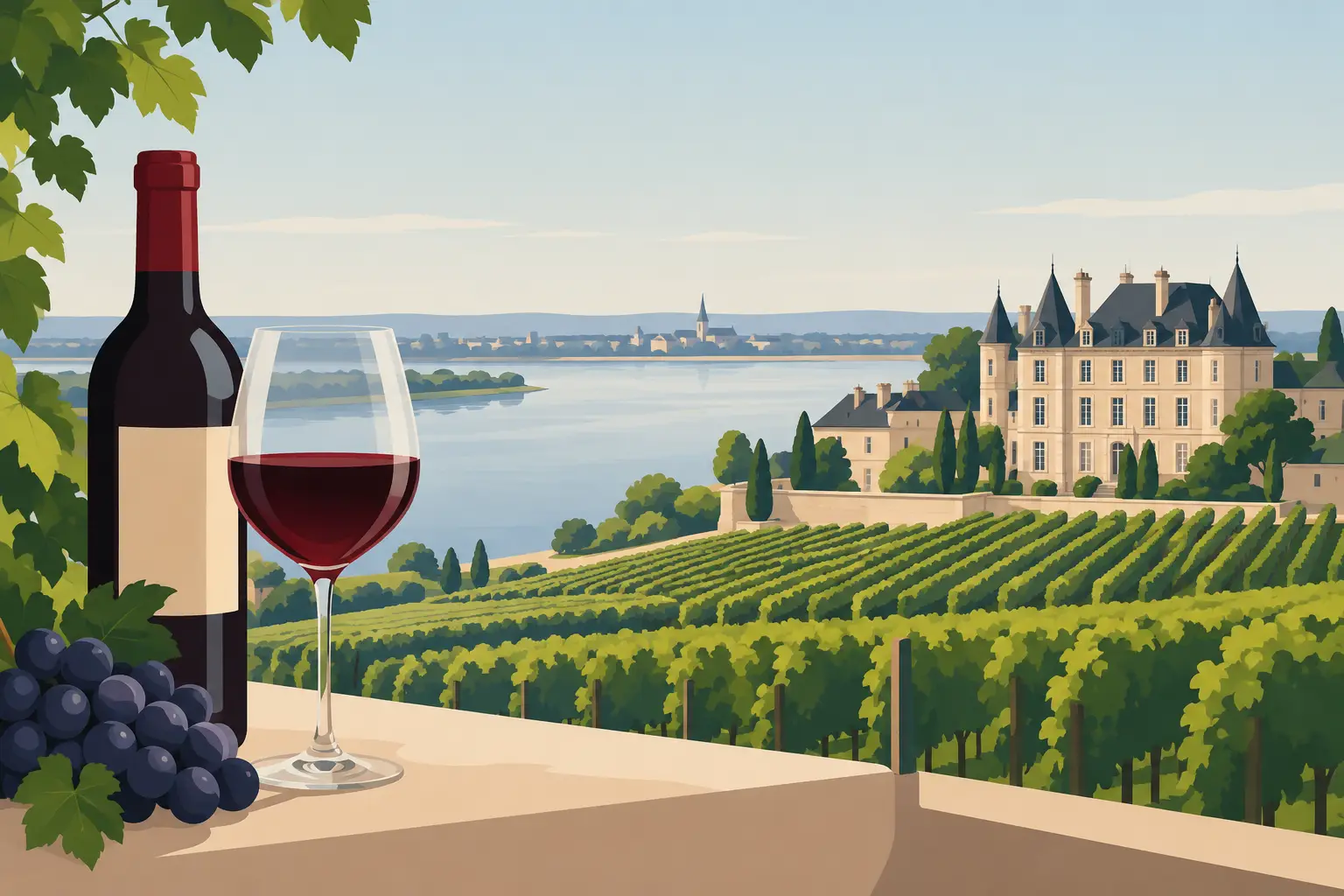
The decisive moment in a Bordeaux left bank guide is not learning the famous château names. It is understanding what those names promise in the glass: Cabernet Sauvignon shaped by gravelly soils, a firm architectural line of tannin, and the capacity to become more aromatic, supple, and complex over decades. For collectors, hosts, and anyone choosing a bottle for a serious dinner, the Left Bank offers both prestige and a remarkably broad range of entry points.
What Defines Bordeaux’s Left Bank?
The Left Bank sits west of the Gironde Estuary and Garonne River. Its best-known territory is the Médoc, a long peninsula north of Bordeaux city, while Graves and Pessac-Léognan lie farther south. The landscape may look modest, but its deep beds of gravel are a major advantage. Gravel drains quickly, encourages vine roots to reach deep into the soil, and stores daytime warmth that helps Cabernet Sauvignon ripen in a maritime climate.
Cabernet Sauvignon is therefore the structural heart of most Left Bank reds. Merlot rounds the mid-palate, while Cabernet Franc, Petit Verdot, and occasionally Malbec add perfume, lift, spice, or color. The blend changes from estate to estate and vintage to vintage, but the classic profile is unmistakable: blackcurrant, cedar, graphite, cigar box, violet, and savory earth, framed by fresh acidity and tannins that reward patience.
This is a different proposition from the Right Bank, where Merlot and Cabernet Franc usually lead. A mature Left Bank wine often feels more linear and restrained at first, then expands with air and bottle age. That tension is precisely why it belongs at the center of so many fine-wine cellars.
Bordeaux Left Bank Guide to the Key Appellations
Pauillac: Power, Cassis, and Longevity
Pauillac is home to several of Bordeaux’s most celebrated first-growth estates, and its reputation is built on authority rather than softness. Expect deep cassis fruit, graphite, cedar, and dense, persistent tannin. The finest examples can evolve magnificently for 30 years or more in a strong vintage.
Pauillac is an obvious choice for a milestone purchase, a collector’s case, or a centerpiece bottle with prime rib. Yet its second wines and leading cru classé neighbors can offer a more approachable route into the appellation, especially when you want its signature Cabernet character without committing to a decades-long wait.
Saint-Julien: The Classicist’s Choice
Saint-Julien is often prized for balance. It combines Pauillac’s dark fruit and structure with a more polished, floral, and composed profile. Tannins can be exceptionally refined, making its leading estates attractive to buyers who want long-term aging potential but also a wine that may show beautifully after 8 to 12 years.
There are no first-growth estates within Saint-Julien, but that fact has little bearing on its quality. The appellation’s most respected properties routinely deliver profoundly complete wines, with a sensational perfume of blackberry, tobacco leaf, sandalwood, and dried flowers as they mature.
Margaux: Fragrance and Finesse
Margaux is the Left Bank at its most perfumed. The wines often show violet, rose petal, red and black currant, exotic spice, and a silky texture that can make even structured vintages feel graceful. This is the appellation to consider when elegance matters as much as concentration.
Margaux can be particularly compelling for dinner parties, where a mature bottle’s fragrance and refined finish pair naturally with roast duck, lamb, mushroom dishes, or herb-crusted beef. Do not mistake its perfume for fragility, however. The strongest estates remain serious cellar wines.
Saint-Estèphe: Structure With a Savory Edge
Saint-Estèphe sits farther north in the Médoc and traditionally produces the most muscular of the four major communal appellations. Its soils include more clay alongside gravel, which can give the wines a cooler, earthier personality. Black plum, cassis, smoke, iron, and savory spice are common markers.
In youth, Saint-Estèphe can be formidable. With age, those tannins resolve into a broad, complex palate that is especially rewarding alongside richly marbled beef, slow-braised short ribs, or game. Modern viticulture and more precise extraction have made many estates more inviting early, but the best bottles still benefit from time.
Haut-Médoc, Moulis, and Listrac: Value Beyond the Famous Villages
The broader Haut-Médoc, along with Moulis and Listrac, deserves attention from buyers who value pedigree without paying exclusively for a marquee commune. Quality varies by producer and site, but these appellations can offer classic cedar-and-cassis character, dependable structure, and excellent drinking windows at more accessible prices.
This is also where vintage selection and producer knowledge matter most. A well-sited estate in a strong year can outperform its reputation, while a modest vintage may be preferable for earlier drinking rather than long-term cellaring.
Graves and Pessac-Léognan: Smoke, Stone, and Great White Wine
South of Bordeaux city, Graves and its leading enclave, Pessac-Léognan, produce distinctive reds with smoky, mineral notes and an often graceful, earthy texture. They are also essential for dry white Bordeaux. Sauvignon Blanc and Sémillon create layered wines with citrus, white peach, beeswax, and smoky flint, capable of remarkable evolution in bottle.
For a sophisticated first course, mature Pessac-Léognan Blanc with lobster, roast chicken, or scallops in a butter-based sauce can be a more memorable choice than defaulting to Burgundy or Champagne.
How to Buy Left Bank Bordeaux With Confidence
The 1855 Classification remains a useful point of reference, particularly in the Médoc. First Growth through Fifth Growth designations identify historic estates, but they are not a complete ranking of present-day quality. Several unclassified châteaux and Cru Bourgeois producers now make excellent wine, while a classified estate’s performance can vary by vintage, investment, and winemaking direction.
Start with your intended drinking window. If you are buying for a dinner within the next few years, look for an estate’s second wine, a mature vintage, or an approachable appellation such as Haut-Médoc. If the goal is a cellar, prioritize strong vintages, proven estates, proper storage history, and original case condition where possible.
Labels also require a little interpretation. A château’s grand vin is its principal bottling, generally sourced from its strongest parcels and vines. Second wines are not simply lesser leftovers. At leading estates, they can be carefully made, estate-specific expressions that offer earlier pleasure and a sensible way to understand a house style.
Critic scores provide a valuable benchmark, particularly for fine-wine purchases, but they should support rather than replace your own preference. A 98-point Saint-Estèphe built for 25 years may be less suitable for this weekend’s dinner than a refined, well-stored 2014 Margaux. The most satisfying buying decision balances score, vintage, provenance, bottle format, budget, and occasion.
Choosing a Vintage for Your Cellar or Table
Bordeaux’s maritime weather means vintage character matters. The excellent 2016s are classical, precise, and built to age. The 2018s are often generous, powerful, and ripe, while 2019 combines richness with freshness and polished tannins. Many 2020s are concentrated and serious, with fine potential for the cellar. The widely praised 2022s offer striking depth and ripe fruit, though their long-term evolution will become clearer with time.
Older, less celebrated years should not be overlooked. A well-made 2014 can offer savory charm and welcome freshness, while mature bottles from 2006, 2008, 2010, or 2012 may be compelling depending on the estate. With mature Bordeaux, provenance is central. Storage conditions, fill level, capsule condition, and the merchant’s sourcing standards matter as much as the vintage on the label.
Serving Left Bank Bordeaux at Its Best
Young, Cabernet-led Bordeaux benefits from air. For a structured recent vintage, decanting for one to two hours can soften the initial grip and reveal more fruit and floral detail. Mature bottles need a gentler approach: stand them upright beforehand to settle sediment, open carefully, and decant only if the wine seems closed or cloudy.
Serve reds slightly below typical room temperature, around 60 to 65°F. Excess warmth makes alcohol more apparent and blurs the wine’s fine detail. A large Bordeaux glass is worthwhile, especially for mature wines whose cedar, dried-leaf, and floral notes emerge gradually.
A great Left Bank bottle does not need an elaborate occasion, only the right one. Choose the maturity and scale to suit the table, give the wine enough air, and let its quiet authority carry the conversation.


