


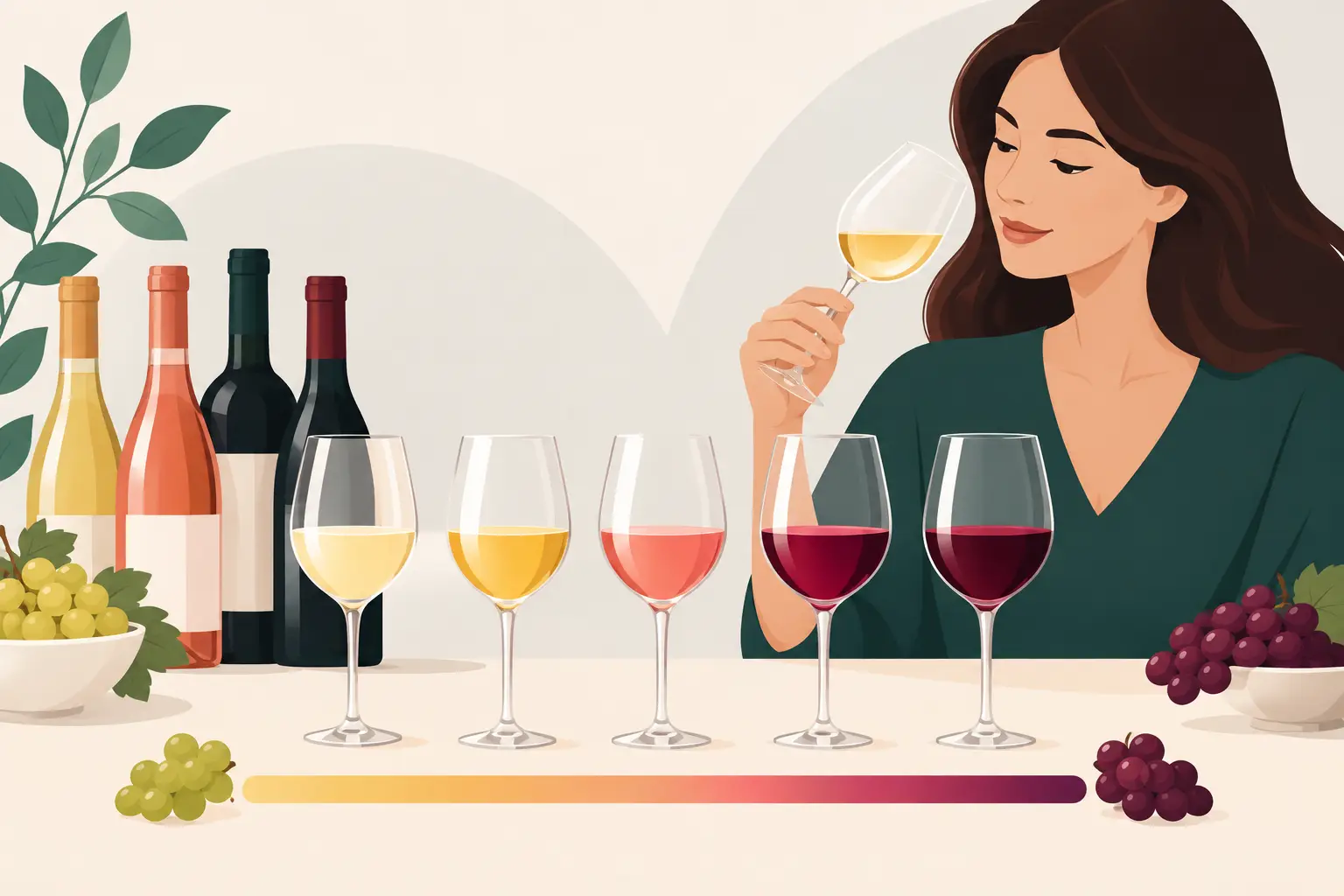
A wine list says “dry,” a bottle mentions late harvest, and a dinner guest asks for something “not too sweet.” To select wine by sweetness confidently, it helps to separate what is technically in the wine from what your palate perceives. Residual sugar matters, but so do acidity, alcohol, bubbles, tannin, fruit ripeness, serving temperature, and the food on the table.
Sweetness is not a marker of quality. A beautifully dry Chablis, a finely balanced German Riesling Spätlese, a mature Sauternes, and a vintage Port can all be exceptional expressions of their styles. The useful question is not whether sweet wine is better than dry wine. It is: how much sweetness will make this bottle most pleasurable for this occasion?
What sweetness means in wine
Sweetness in wine usually refers to residual sugar, or the natural grape sugar left behind after fermentation. When yeast converts nearly all sugar into alcohol, the result is dry wine. When fermentation stops before all the sugar is consumed, the wine retains residual sweetness.
In practical terms, still wines are often described as dry, off-dry, medium-sweet, or sweet. The boundaries are not always fixed, because acidity can dramatically change the impression. A Riesling with noticeable residual sugar may taste racy and almost dry when its acidity is piercing. By contrast, a low-acid wine with a similar sugar level can seem distinctly sweet and broad.
That is why ripe fruit aromas should not be mistaken for sugar. A plush California Cabernet may suggest blackberry jam, vanilla, and chocolate while remaining technically dry. An aromatic Gewürztraminer can smell of lychee and rose petals yet range from dry to sweet depending on the producer and vintage.
How to select wine by sweetness from the label
Wine labels do not always state a residual sugar figure, so reading the clues is part of the pleasure. Start with the producer’s style, the region, and the language used on the bottle.
Terms such as dry, sec, trocken, and secco generally signal a dry style, although sparkling-wine terminology follows its own rules. Off-dry, demi-sec, feinherb, halbtrocken, and medium dry indicate some sweetness, with the exact level varying by country and producer. Sweet wines may be labeled late harvest, vendange tardive, Auslese, Beerenauslese, Trockenbeerenauslese, ice wine, vin doux naturel, or simply dessert wine.
A vintage and appellation can offer equally useful information. Red Bordeaux, Barolo, Brunello di Montalcino, Burgundy, and most serious Rhône reds are made dry, even when their fruit is generous and sun-ripened. Sancerre, Chablis, Muscadet, Albariño, and many Pinot Grigios are also dependable dry choices.
There are exceptions worth respecting. Vouvray may be bone-dry, gently off-dry, or sweet. Chenin Blanc from the Loire is wonderfully versatile precisely because producers make it across the sweetness spectrum. Riesling is even more nuanced: Alsace Riesling is often dry, while German Riesling can range from dry to richly sweet, sometimes with only subtle labeling cues.
Sparkling wine terms can be counterintuitive
For Champagne and other traditional-method sparkling wines, “Brut” is the familiar dry choice, but it is not necessarily bone-dry. Extra Brut and Brut Nature are drier, while Extra Dry is actually slightly sweeter than Brut. Sec and Demi-Sec are progressively sweeter styles.
For an aperitif or with oysters, sashimi, fried snacks, and lightly seasoned canapés, choose Brut Nature, Extra Brut, or Brut. For fruit desserts, afternoon tea, or mildly spicy dishes, a Demi-Sec Champagne can be a more harmonious and unexpectedly refined choice.
Use grape varieties as a reliable starting point
When a label is unfamiliar, grape variety can quickly narrow the field. Cabernet Sauvignon, Merlot, Syrah, Pinot Noir, Tempranillo, Nebbiolo, Sangiovese, Chardonnay, Sauvignon Blanc, and Grüner Veltliner are conventionally vinified dry. Their body and fruit profile may differ considerably, but sweetness is rarely the central issue.
For a lightly sweet or off-dry style, look first to Riesling, Chenin Blanc, Moscato, Gewürztraminer, and some Pinot Gris or Grüner Veltliner bottlings. Moscato d’Asti is particularly useful for those who want low alcohol, fragrant peach and orange-blossom character, gentle fizz, and clear sweetness without the weight of a dessert wine.
For truly sweet wine, grape variety and method matter. Sémillon and Sauvignon Blanc in Sauternes or Barsac can develop honey, saffron, apricot, and marmalade complexity through noble rot. Tokaji, made principally from Furmint, brings vivid acidity to its luscious sweetness. Ice wine offers concentrated citrus and stone-fruit intensity, while fortified wines such as Port bring more alcohol, density, and warmth.
A good merchant can help distinguish between a grape’s aromatic ripeness and its actual sweetness level. This is especially valuable with Riesling, where a dry Grosses Gewächs and a noble-sweet Beerenauslese may share the same grape and country but deliver entirely different experiences.
Let acidity decide whether sweetness feels refreshing
The finest sweet wines do not merely taste sugary. They carry enough acidity to keep the finish energetic, defined, and long. Think of lemon juice in a tarte Tatin: it does not remove sweetness, but it gives the dessert lift and prevents richness from becoming tiring.
This balance explains why Riesling is such a compelling food wine. A Kabinett with modest sweetness and electric acidity can refresh the palate alongside Thai curry, glazed pork, or spicy grilled prawns. Its sweetness softens chili heat, while its acidity keeps the pairing bright.
Alcohol changes the equation, too. A low-alcohol off-dry Riesling may feel light and delicate. A sweet fortified wine, such as Tawny Port, feels richer because sugar, alcohol, dried-fruit flavors, and oxidative notes arrive together. Neither is inherently more indulgent, but they suit different moments.
Serving temperature also affects perception. Chill sweet and off-dry whites properly, usually more firmly than a full-bodied dry Chardonnay. A cooler temperature makes sweetness appear cleaner and preserves the wine’s freshness. If a bottle seems cloying as it warms, return it to an ice bucket rather than judging it too quickly.
Match the sweetness to the food, not just the dessert
Sweetness is one of the most useful tools in food pairing. With spicy food, a dry red with high tannin can make chili feel more aggressive and bitter. An aromatic off-dry white, by contrast, can calm the heat and complement sweet-savory sauces.
For salty dishes, sweetness creates an attractive contrast. Blue cheese with Sauternes, foie gras with late-harvest Chenin Blanc, or aged Parmigiano with Vin Santo are classic examples because salt makes the wine’s fruit seem even more vivid. With savory dishes featuring caramelized onions, roast duck, char siu, or sweet glazes, a medium-bodied red with ripe fruit may work beautifully, even though it is technically dry.
Dessert requires a firmer rule: the wine should be at least as sweet as the dish. If the dessert is sweeter than the wine, even a generous off-dry bottle can taste thin, tart, or bitter. Pair a citrus tart with late-harvest Riesling, crème brûlée with Sauternes, chocolate with Banyuls or Vintage Port, and fresh berries with Moscato d’Asti.
Do not force sweet wine into every final course. With a lightly sweet dessert, a demi-sec sparkling wine can be ideal. With very rich chocolate, coffee, or blue cheese, a small pour of fortified wine may be more satisfying than a large glass of any table wine.
A practical buying approach for every occasion
Begin with the drinking context. If you are opening a bottle before dinner, dry sparkling wine or a crisp dry white is the safest starting point. If you are serving aromatic Southeast Asian food, consider off-dry Riesling or Chenin Blanc. If dessert is central to the evening, select a sweet wine with freshness rather than choosing the sweetest bottle available.
Then decide how expressive you want the sweetness to be. A guest who says they dislike sweet wine may still enjoy a dry red with ripe fruit, a Brut Champagne, or a high-acid Riesling with a discreet touch of residual sugar. Someone who genuinely enjoys sweetness may prefer Moscato d’Asti for its easy charm, or a mature Sauternes for its layered, cellar-worthy complexity.
For gifting, sweetness can be particularly personal. A prestige dry Champagne is broadly versatile and celebratory. A fine Tokaji, vintage Port, or late-harvest wine feels more considered when you know the recipient enjoys dessert wines, cheese pairings, or after-dinner conversation. Bottle size matters as well: half bottles are often ideal for sweet wine, whose intensity rewards smaller pours.
At Crystal Wines, the most confident choice often starts with a simple conversation about the menu, the guest of honor, and whether the desired style is dry, gently off-dry, or unambiguously sweet. A well-chosen bottle should not merely match a category on a label. It should make the next course, toast, or shared evening taste more memorable.


