


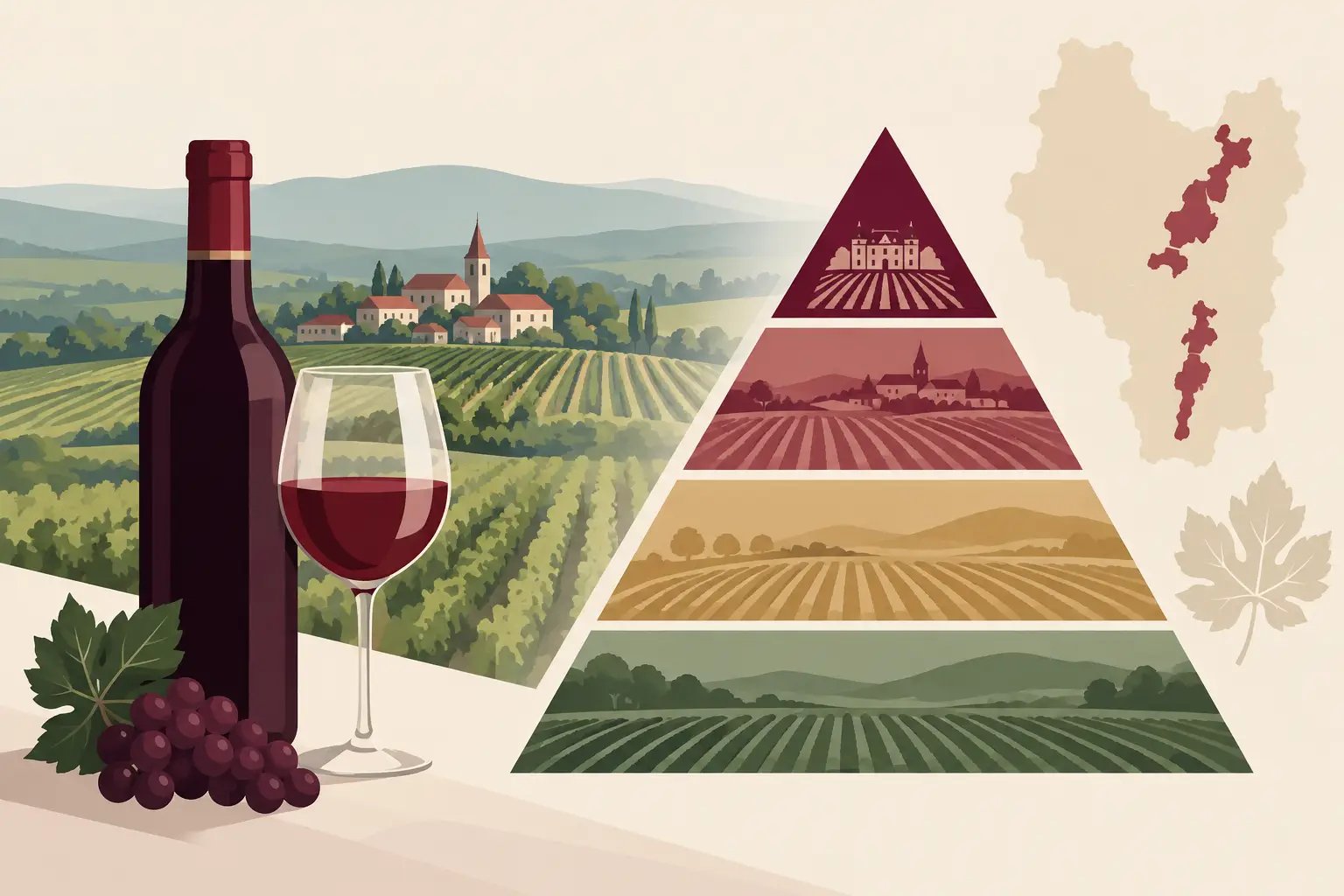
A Burgundy label can appear deceptively spare: a producer name, a vintage, perhaps a vineyard, and a village most wine drinkers have never visited. Yet those few words can signal the difference between a graceful weeknight bottle and a collector-worthy wine with decades of potential. This Burgundy vineyard hierarchy guide helps make sense of that difference, while keeping sight of what matters most in the glass: producer, site, vintage, and the occasion you are buying for.
Why Burgundy’s hierarchy matters
Burgundy is not organized like Bordeaux, where château names often dominate a purchase decision. Here, the vineyard is the essential unit of meaning. A single hillside can be divided among many growers, each farming and vinifying a small parcel. Two bottles carrying the same appellation may therefore offer very different levels of precision, perfume, texture, and aging ability.
The formal classification gives buyers a useful starting point. It runs from regional Burgundy through village wines and Premier Cru to Grand Cru. But it is a hierarchy of legally defined appellations, not an absolute ranking of every bottle. An exceptional producer’s Bourgogne can easily be more compelling than a carelessly made village wine, while a fine Premier Cru may offer greater value and more immediate pleasure than a young Grand Cru.
For collectors and enthusiastic drinkers, the hierarchy narrows the field. It tells you where the grapes were grown, how narrowly the origin is defined, and often what level of complexity and scarcity to expect.
The Burgundy vineyard hierarchy, from broad to precise
Regional appellations: Burgundy’s entry point
At the broadest level are regional wines, most commonly labeled Bourgogne. These may be made from grapes grown across a wide part of Burgundy, though the rules vary by color and appellation. Bourgogne Pinot Noir and Bourgogne Chardonnay are the familiar examples, alongside more specific regional designations such as Bourgogne Côte d’Or.
These wines are not merely introductory labels. In the hands of a serious domaine or négociant, they can offer bright fruit, lively acidity, and a clear glimpse of the producer’s style. For buyers exploring a new name, regional Burgundy is often the most sensible first purchase. It also suits restaurant tables and relaxed entertaining, where freshness and drinkability matter more than a lengthy cellar evolution.
The trade-off is breadth. A regional designation generally says less about a specific slope, soil type, or microclimate than the tiers above it. Prices can be more approachable, but the wines are also usually less scarce and less structured for extended aging.
Village appellations: the personality of place
Village wines name a specific commune, such as Gevrey-Chambertin, Volnay, Meursault, Chablis, or Puligny-Montrachet. This is where Burgundy’s geographic vocabulary begins to become especially expressive.
A village name offers an important stylistic cue, although it should never be treated as a rigid formula. Gevrey-Chambertin is often associated with savory, structured Pinot Noir; Volnay can show fragrant red fruit and refined tannins; Meursault is celebrated for layered Chardonnay with breadth and mineral drive. Producer choices, vintage conditions, and individual parcels all shape the final wine.
For many experienced buyers, village Burgundy represents a sweet spot. It can communicate real appellation character without the price escalation attached to top named vineyards. A strong vintage from a respected grower can be deeply rewarding after several years in the cellar, while many bottles are also approachable with a short decant.
Watch for labels that add a vineyard name below the village appellation. A wine labeled, for example, with a village followed by a lieu-dit may come from a recognized parcel that has not been classified as Premier Cru. These wines can be fascinating purchases, particularly when the site sits close to a more famous classified vineyard.
Premier Cru: a sharper view of the slope
Premier Cru, often written as 1er Cru, identifies a designated vineyard or group of vineyards within a village appellation. Burgundy has hundreds of Premier Cru sites, and their quality can vary considerably. That variation is precisely why the producer becomes even more important at this level.
A Premier Cru bottling usually carries both the village and vineyard name, such as Chambolle-Musigny 1er Cru Les Amoureuses or Beaune 1er Cru Clos des Mouches. These wines tend to offer more concentration, aromatic detail, and site-specific character than standard village bottlings. The best combine immediate seduction with the structure to develop gracefully over a decade or longer.
Premier Cru is also the tier where careful buying can be especially rewarding. Not every celebrated name is automatically superior to every less familiar site. Exposure, elevation, drainage, vine age, and a grower’s holdings all matter. Some Premier Crus approach Grand Cru quality in exceptional years, while others are best valued for their earlier accessibility and finesse.
For a dinner built around roast duck, pigeon, mushroom dishes, or aged Comté, mature Premier Cru red Burgundy can be remarkably persuasive. White Premier Cru from Chassagne-Montrachet, Puligny-Montrachet, or Meursault can bring enough depth for butter-poached seafood, poultry, or richer Cantonese preparations without overwhelming the table.
Grand Cru: Burgundy’s rarest sites
Grand Cru is Burgundy’s highest formal classification. These vineyards are few, tightly defined, and often tiny. Names such as Le Chambertin, Musigny, Clos de Vougeot, Corton-Charlemagne, Montrachet, and Chevalier-Montrachet carry enormous prestige because the sites have repeatedly demonstrated an ability to produce wines of unusual depth, complexity, and longevity.
A Grand Cru label generally names the vineyard rather than the village. The village may appear in smaller print, but the vineyard is the headline. Grand Cru wines can be breathtakingly layered: Pinot Noir may move from rose petal and wild strawberry to forest floor, spice, and game with age; Chardonnay can bring citrus oil, hazelnut, crushed stone, and a breathtakingly long finish.
Prestige does not eliminate judgment. Grand Cru prices reflect scarcity, global demand, and producer reputation as much as classification. A bottle may need 10 to 20 years, sometimes longer, to show its full dimension. It is a magnificent category for milestone gifting, serious cellaring, and collectors seeking pristine provenance, but it is not automatically the right answer for a near-term dinner.
Read the label beyond the classification
The hierarchy is the framework, but several details deserve equal attention. First, identify the producer. Burgundy’s fragmented ownership means the name on the bottle can matter as much as the vineyard. A meticulous domaine with a small parcel in a modest appellation may outperform a larger, less precise operation in a celebrated site.
Second, consider the vintage. Cooler years may emphasize tension, perfume, and structure; warmer years can offer more generous fruit and earlier appeal. This is not a simple good-versus-bad calculation. Lovers of classical freshness may prefer one profile, while those opening bottles sooner may favor another. Critic scores can provide valuable context, but producer-specific notes are often more useful than a broad regional verdict.
Third, distinguish domaine bottlings from négociant wines. A domaine generally bottles fruit from vineyards it owns or farms. A négociant may purchase grapes, must, or finished wine, often drawing on long-standing grower relationships. Neither model is inherently better. The question is whether the house has a disciplined sourcing and winemaking record.
Finally, pay attention to bottle condition and storage. Burgundy is especially sensitive to provenance. For mature bottles and collector purchases, reliable storage history, fill level, capsule condition, and trusted merchant sourcing deserve the same scrutiny as the appellation printed on the label.
How to buy Burgundy for the way you drink
If you are opening a bottle this weekend, a well-made regional or village Burgundy is often the wisest choice. Seek recent vintages with appealing fruit and choose a producer known for balance rather than sheer extraction. For gifts, a recognizable village or Premier Cru carries both prestige and a story worth sharing.
If you are building a cellar, buy across tiers instead of concentrating only on Grand Cru. Regional wines can provide early enjoyment, village bottles reveal house style, Premier Cru brings site definition, and a select number of Grand Crus can anchor long-term holdings. Buying two or three bottles of a wine you admire also makes practical sense: one can be opened young, another after several years, and a final bottle at maturity.
White Burgundy merits the same disciplined approach. Chablis, Côte de Beaune Chardonnay, and the great wines of the Côte Chalonnaise each operate within their own landscape and price logic. A celebrated Grand Cru white can be extraordinary, but a finely made village Meursault or Premier Cru Chablis may be the more versatile choice for a Singapore dinner where seafood is central.
Crystal Wines can help match a producer, vintage, and drinking window to your plans, whether you are choosing a polished first bottle or adding a serious vineyard name to a growing cellar. The most satisfying Burgundy purchase is rarely the one with the grandest label alone. It is the bottle whose provenance, place, and maturity suit the people gathered around your table.


