


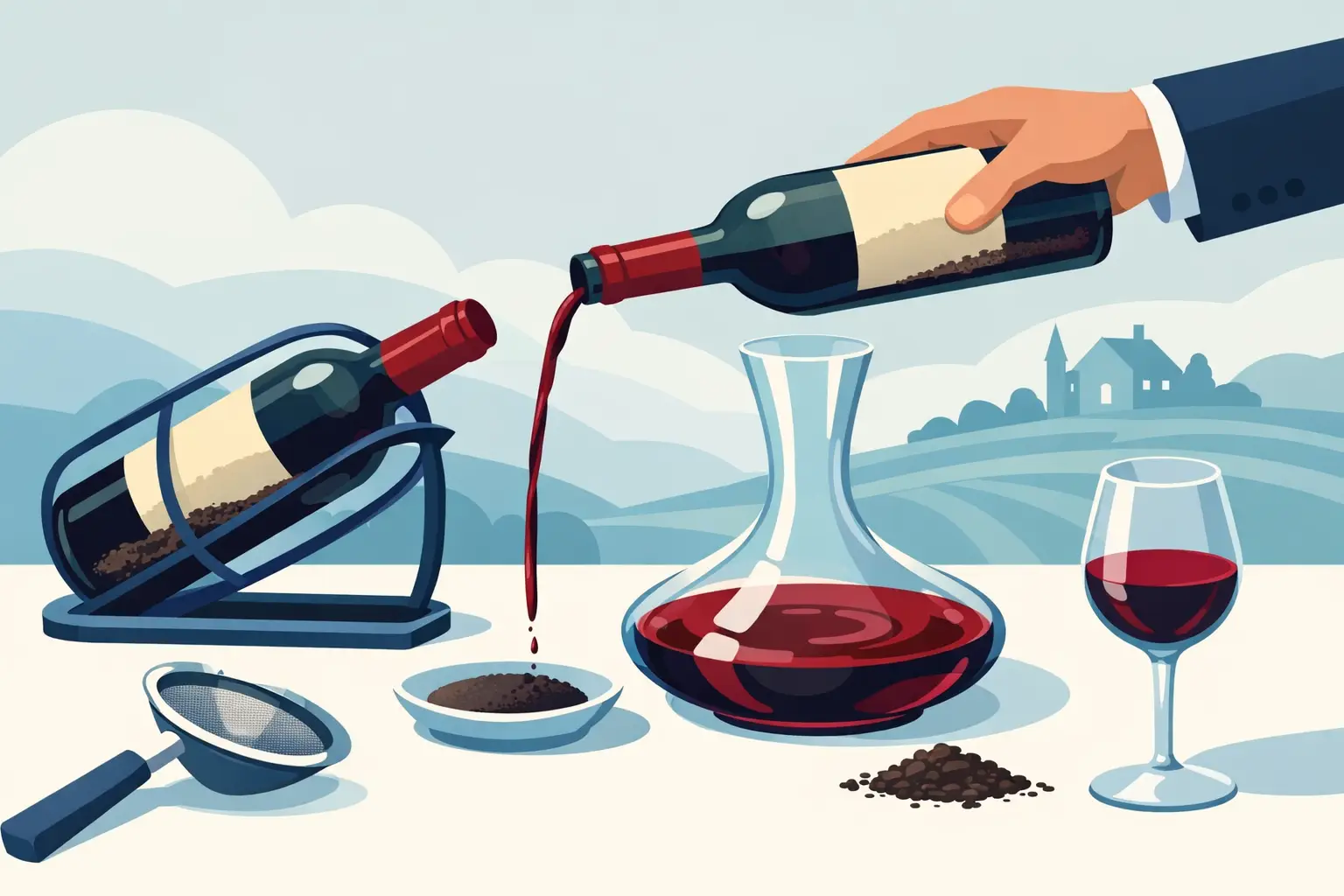
A mature bottle of Bordeaux can deliver the most moving kind of wine experience: cedar, tobacco leaf, dried rose, graphite, and softened blackcurrant unfolding with quiet authority. Knowing how to decant aged Bordeaux is less about dramatic aeration than careful handling. The aim is simple: separate clear wine from its sediment while preserving the fragile perfume that decades in bottle have created.
For an old classified growth, a treasured Saint-Émilion, or a beautifully stored Pomerol, restraint is usually the mark of good service. Young Bordeaux often benefits from air. Aged Bordeaux may need only a gentle transfer and a short pause before it reaches the table.
Why aged Bordeaux needs a different approach
As Bordeaux matures, its tannins polymerize and naturally fall out of suspension, forming a fine deposit in the bottle. This sediment is harmless, but it feels gritty and bitter on the palate. Decanting leaves it behind, allowing the wine’s silky texture and layered aromatics to show clearly.
The complication is oxygen. An old wine has already evolved slowly over many years. A broad decanter and several hours of exposure can cause its fruit to fade quickly, replacing its sensational perfume with muted, tired notes. There is no universal schedule based on age alone. Storage history, vintage character, bottle format, fill level, and the individual bottle all matter.
A well-cellared 1982 or 1990 Bordeaux with a high fill may still have remarkable vitality. A more delicate bottle from the 1970s, particularly one with a lower fill or uncertain provenance, may be at its most expressive the moment it is opened. Decant for sediment, not automatically for air.
How to decant aged Bordeaux step by step
Stand the bottle upright well in advance
Place the bottle upright at least 24 hours before serving. For a very old bottle or one that has traveled recently, 48 hours is better. This gives the sediment time to settle at the base rather than remain suspended throughout the wine.
Avoid unnecessary movement after standing it up. If the bottle has been stored on its side in a cellar or wine refrigerator, carry it gently and do not rotate it before opening. A bottle cradle or decanting basket can be helpful for exceptionally old bottles, but it is not essential if you can pour slowly and steadily.
Prepare the right tools and serving conditions
Use a clean, neutral-smelling decanter, ideally with a narrow to medium-width base. A large, wide-bottomed vessel designed to rapidly aerate young Cabernet Sauvignon is rarely the best choice for mature claret. You will also need a corkscrew suited to fragile corks, such as an Ah-So or a Durand-style opener, plus a small light source.
A candle has long been part of the ritual, but a phone flashlight or small lamp is more practical and safer. The light is not there for theater. It allows you to see the dark line of sediment moving toward the shoulder of the bottle as you pour.
Serve mature red Bordeaux slightly cool, generally around 60 to 65°F. In a warm dining room, particularly in Singapore’s climate, the wine can rise in temperature quickly. Keep the bottle or decanter in a cool room until guests are ready, rather than serving it at room temperature in the literal sense.
Open the bottle with patience
Remove the capsule and wipe the neck clean. Old corks are often soft, saturated, or brittle, even when the wine beneath them is in excellent condition. Insert your chosen opener slowly and extract the cork with minimal twisting. If it crumbles, do not panic or force the remaining pieces downward.
Use an Ah-So around the cork’s sides, or carefully lift loose fragments with a corkscrew. Should small particles fall into the bottle, decanting through a fine, clean metal strainer is acceptable. It is better to remove cork fragments than to abandon a potentially magnificent bottle over a flawed closure.
Before decanting, smell the wine at the neck and pour a small taste. This quick check tells you whether the wine is sound and gives a first indication of its condition. Notes of damp cellar, mushroom, leather, and forest floor can be entirely normal in mature Bordeaux. Persistent wet cardboard or a stripped, dull character may suggest cork taint, while sharp vinegar aromas point to a more serious fault.
Pour in one slow, continuous motion
Hold the bottle over the light and begin pouring gently into the decanter. Keep the neck angled so you can watch the wine as it passes through the shoulder. Do not stop and start repeatedly, as this stirs the sediment.
When you see a cloudy stream, dark particles, or a dense deposit approaching the neck, stop immediately. Leaving behind an ounce or two of wine is a small price for clean, refined glasses. With very old bottles, the sediment can be substantial, and the final pour may look almost muddy. That is entirely normal.
If you are using a decanting basket, keep the bottle in the basket throughout opening and pouring. Otherwise, a stable hand and unhurried pace are enough. Decanting aged Bordeaux is a quiet table-side skill, not a test of speed.
How long should aged Bordeaux sit in the decanter?
Taste the wine immediately after decanting. For bottles around 15 to 25 years old, 20 to 45 minutes may allow the aromas to open without losing definition. A vigorous, well-preserved vintage can occasionally benefit from an hour. Beyond that, taste regularly rather than relying on a fixed rule.
For bottles approaching 30 years or more, serve within 15 to 30 minutes unless the first taste clearly suggests reserve and firmness. Some mature wines improve in the glass rather than in the decanter, revealing truffle, cigar box, and savory complexity gradually over the course of dinner.
There is also a compelling alternative: decant immediately before serving and pour small first glasses. Revisit the wine every 10 minutes. This lets guests experience its evolution and protects a fragile bottle from unnecessary exposure. For a special dinner, this is often more rewarding than presenting a fully opened wine at a predetermined moment.
When not to decant
An aged Bordeaux with a very low fill level, a compromised cork, or a notably pale, delicate appearance should be handled with particular caution. Open it, assess it, and consider pouring directly from the bottle through a fine strainer only if sediment is evident. The wine may be fleeting but still beautiful.
Do not double-decant an old bottle simply to return it to its original bottle for presentation. The extra handling offers little benefit and adds oxygen exposure. Equally, avoid using a wine aerator. These tools are useful for some young, tightly wound reds, but their forceful action can flatten the nuanced bouquet that makes mature Bordeaux so distinctive.
Choosing the decanter and glassware
The best decanter for aged Bordeaux is clear, spotless, and free of detergent or cabinet odors. A medium-bodied shape is ideal: enough surface area to release aroma, but not so much that the wine is spread thinly across a vast base. Rinse it with a little of the wine if desired, then discard that rinse before the main pour.
Use generous tulip-shaped Bordeaux glasses rather than oversized bowls. Mature wines do not need aggressive swirling. A glass with a tapered rim gathers their perfume, allowing subtle notes of pencil shavings, tea leaf, cassis, and autumnal earth to emerge without being overwhelmed by alcohol.
At Crystal Wines, the most useful advice for a significant old bottle is often vintage- and producer-specific. A powerful left-bank Cabernet blend and a supple, Merlot-led right-bank wine of the same age can ask for very different timing. When provenance and storage are known, that detail is as valuable as the estate name on the label.
Serve it with the meal, not before the moment
Mature Bordeaux is at its best alongside food that respects its refinement. Roast lamb, beef tenderloin, duck, mushroom dishes, and aged hard cheeses work beautifully, especially when sauces are savory rather than sweet. Avoid intense chile heat or heavily sweet glazes, which can make an old wine seem thinner and more drying.
Once the bottle is open, let the wine lead the pace. If its perfume is soaring, pour it. If it seems closed but sound, give it a little more time and taste again. The finest aged Bordeaux rarely rewards a rigid timetable. It rewards attention, a steady hand, and the pleasure of sharing a bottle at precisely the point when it has something unforgettable to say.


