


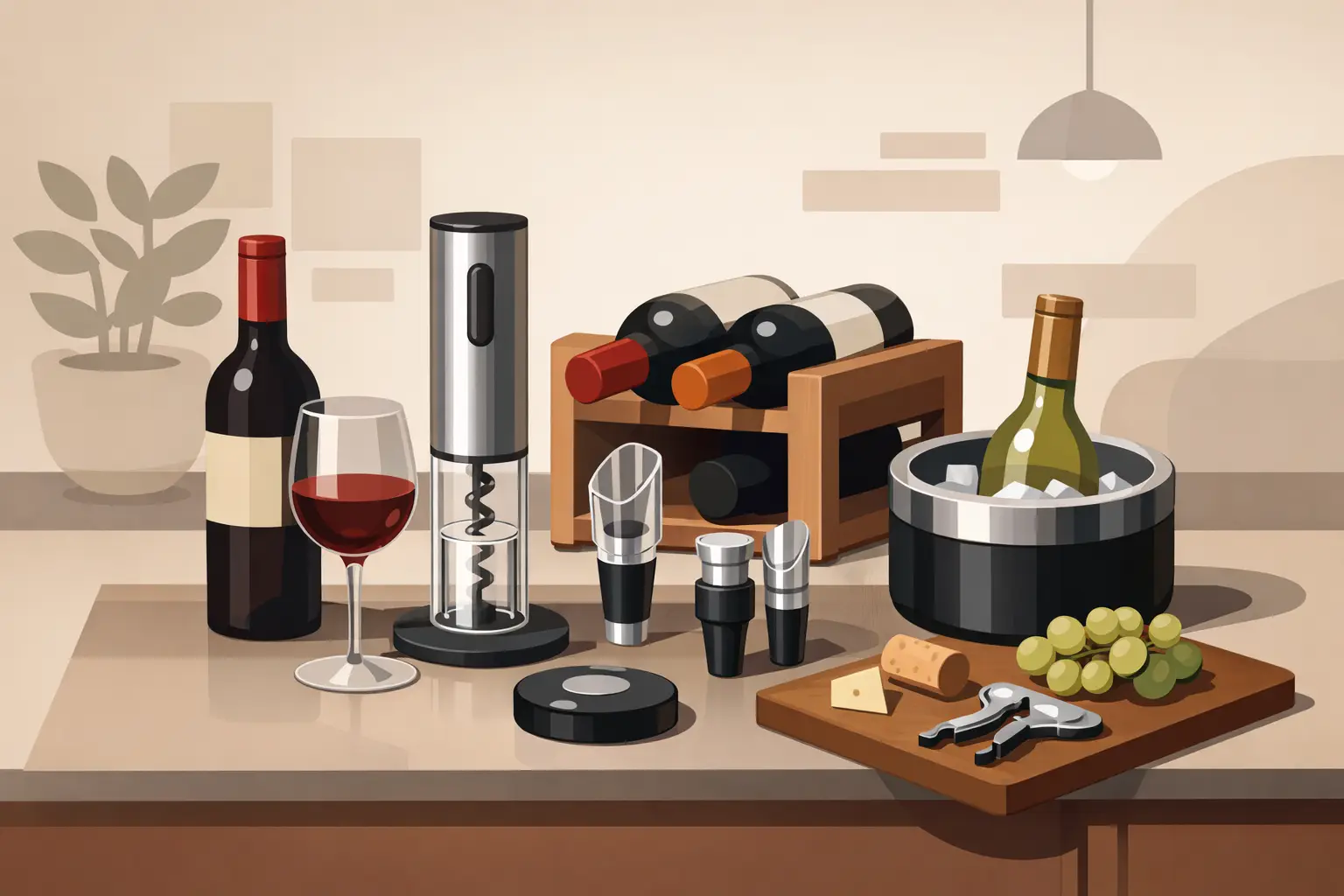
A great bottle can be diminished by a blunt opener, a warm serving temperature, or a rushed pour into the wrong glass. The best wine accessories are not decorative extras for a bar cart. They are practical tools that protect a bottle’s condition, reveal its character, and let a host serve with the same care that went into choosing the wine.
For a mature Bordeaux, a structured Barolo, or a young Champagne with electric freshness, the right tool depends on the bottle in front of you. A compact apartment does not need every gadget available. It does need a considered set of essentials that makes opening, chilling, decanting, and preserving wine more assured.
Wine accessories worth buying first
Start with the accessories that solve recurring problems. These will earn their drawer space whether you are opening an everyday red on a weeknight or serving a special vintage to guests.
A reliable corkscrew
A quality waiter’s friend remains the most useful wine tool for most homes. Look for a double-hinged lever, a sharp serrated foil cutter, and a substantial worm with a non-stick coating. The double hinge gives better leverage and reduces the risk of a broken cork, particularly with longer natural corks found in fine wine.
Avoid very inexpensive openers with thin worms or loose hinges. They can tear into the cork rather than draw it out cleanly, which is frustrating with any bottle and particularly painful when the label reads a respected producer or a carefully cellared vintage.
For older wines, a two-prong cork puller, often called an Ah-So, is a sensible addition. Its slim prongs slide between cork and glass, allowing fragile corks to be eased out rather than drilled through. It takes a little practice, but it is far preferable to filtering cork fragments from a mature bottle of Saint-Émilion or Burgundy.
Proper stemware
Glassware has a more noticeable effect on enjoyment than many drinkers expect. A well-made stemmed glass gives the wine room to breathe, concentrates aroma, and allows you to hold the glass without warming the bowl. It also makes swirling safer and more comfortable.
You do not need separate glasses for every grape variety. A versatile set of medium-to-large tulip-shaped glasses will flatter most red, white, and sparkling wines. If you regularly enjoy Champagne, add a broader tulip glass rather than relying exclusively on narrow flutes. The wider bowl gives aromatic vintage Champagne more room to show its brioche, citrus, and mineral notes while retaining a lively stream of bubbles.
Fine crystal can be a pleasure, especially for special bottles, but durability matters when you entertain often. Thin, dishwasher-safe glassware can be the more practical choice for relaxed dinners. The best glass is one you will use confidently, not one that stays boxed away for fear of breakage.
A decanter chosen for the wines you drink
Decanting serves two different purposes. With a young, concentrated red, it introduces oxygen and can soften the impression of firm tannins, bringing dark fruit, floral perfume, and savory detail forward. With an older bottle, decanting is mainly about separating clear wine from sediment.
A broad-based decanter is effective for young Cabernet Sauvignon, Syrah, Barolo, and Brunello di Montalcino because its larger surface area encourages aeration. For mature wine, choose a more modest vessel and decant slowly. Older wines can lose their most delicate aromas if left exposed for too long, so there is no fixed rule that more air is always better.
A decanter is not mandatory for every red. A bright, youthful Beaujolais or supple Pinot Noir may be more expressive after a simple opening and a short rest in the bottle. Taste first, then decide. This is a more reliable approach than decanting by habit.
Serving tools that preserve precision
The difference between a good pour and an excellent one often comes down to temperature and timing. This is where a few focused wine accessories make hosting feel effortless without becoming overly ceremonial.
An ice bucket and wine sleeve
White wine and Champagne are frequently served too warm in homes and restaurants alike. An ice bucket filled with water and ice chills a bottle much faster than ice alone, while an insulated wine sleeve is useful when space is limited or when taking a bottle to a dinner.
A full-bodied white Burgundy may show best slightly less cold than a crisp Sauvignon Blanc, while Champagne can be chilled thoroughly and allowed to open gradually in the glass. For reds in warm climates, a brief 15 to 20 minutes in the refrigerator can bring a bottle closer to its ideal serving range. “Room temperature” was never meant to describe a tropical afternoon.
A wine thermometer
A thermometer is especially valuable when serving premium bottles whose balance can be obscured by heat. Excess warmth makes alcohol feel prominent and fruit seem heavy; excessive cold can mute aroma and tighten texture.
An inexpensive bottle thermometer is useful, though an instant-read probe is more precise. You do not need to measure every bottle, but it is worth checking when opening Champagne, aromatic whites, aged reds, or a wine selected for a dinner where food pairing matters. A refined bottle deserves a fair introduction.
A drip-free pourer
This may be the least glamorous tool in the cabinet and one of the most appreciated. A simple reusable pourer helps direct the flow of wine cleanly into the glass and prevents red-wine drips from reaching a white tablecloth. It does not improve the wine, but it makes serving more composed.
Be cautious with pourers that promise dramatic instant aeration. Some can be helpful for a simple young red, yet they are not a substitute for time in a decanter and are rarely appropriate for mature, nuanced bottles. The more complex the wine, the less you should force the process.
Preserving an unfinished bottle
Not every bottle needs to be finished at one sitting. A preservation stopper is valuable for anyone who likes to compare wines over several evenings, enjoy a glass with dinner, or open a serious bottle without feeling obliged to rush it.
A basic vacuum pump and stopper can slow oxidation for a short period, usually enough for everyday wines over the next day or two. It is affordable and convenient, but it removes some aroma along with air, so it is not ideal for delicate older bottles.
For more expensive wines, an inert-gas preservation system is a stronger choice. These systems replace oxygen in the bottle with gas, helping retain freshness after opening. Needle-based systems can even pour wine through the cork without removing it, a compelling option for collectors who want to taste a prized bottle while preserving the rest. The trade-off is cost, and the need to keep replacement gas capsules on hand.
Whatever method you use, refrigerate opened bottles, including reds. Cooler temperatures slow oxidation. Bring red wine back toward serving temperature before pouring again, and always taste before deciding whether it still has the vibrancy you want.
The accessories collectors should not overlook
For a growing cellar, good storage practices matter more than novelty tools. Keep bottles away from direct light, vibration, and temperature swings. Bottles sealed with natural cork should generally rest on their sides so the cork remains moist, while screw-cap bottles can be stored upright or on their side without concern.
A small cellar notebook or digital inventory is also a remarkably useful accessory. Record producer, vintage, purchase date, quantity, storage location, and any critic score or drinking-window guidance that informed the purchase. When a collection expands beyond a few shelves, this record prevents exceptional bottles from being forgotten until their best moment has passed.
For presentation and gifting, a sturdy wine carrier or wooden gift box provides more value than elaborate packaging alone. It protects the bottle in transit and gives a thoughtful Champagne, single-vineyard Pinot Noir, or benchmark Bordeaux a sense of occasion before the cork is even drawn.
The most rewarding wine accessories share one quality: they make you more attentive to the bottle, not more distracted by equipment. Build your collection slowly, beginning with a dependable opener, good glasses, temperature control, and a preservation method that matches how you drink. Then let the bottle, the food, and the people around the table do the rest.


